Gluing or Glueing: Which Spelling Is Correct? 🧴✍️
Have you ever typed a sentence like “I’m glueing the pieces together” and paused for a second? 🤔 The confusion between Gluing or Glueing is very common because English spelling rules can feel tricky when verbs change form. One small extra letter can make a big difference and even confuse experienced writers.
The issue around Gluing or Glueing happens because English often drops the silent e before adding -ing, but many people are unsure whether it should stay or be removed. Since glue ends in e, writers often wonder which spelling is correct.
This question appears in emails, schoolwork, workplace writing, and social media captions. If you’ve ever been unsure whether to write gluing or glueing, you’re definitely not alone. 😊
In this article, we’ll clearly explain the correct spelling, grammar rules, common mistakes, and real-life usage so you never get confused again.
Quick Answer: Gluing or Glueing
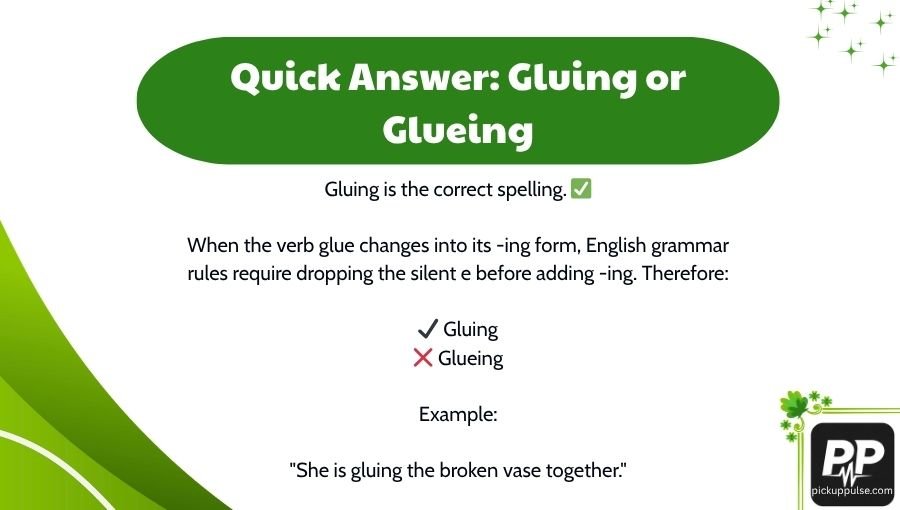
Gluing is the correct spelling. ✅
When the verb glue changes into its -ing form, English grammar rules require dropping the silent e before adding -ing. Therefore:
✔ Gluing
❌ Glueing
Example:
“She is gluing the broken vase together.”
Understanding the Basics of Gluing or Glueing
The confusion comes from how English handles verbs ending in e.
Most verbs ending in a silent e drop that e before adding -ing.
Examples:
- make → making
- write → writing
- bake → baking
- glue → gluing
Here is a simple comparison:
| Form | Type | Meaning | Example | Correct/Incorrect |
|---|---|---|---|---|
| Gluing | Present participle | Joining objects with adhesive | “He is gluing cardboard pieces.” | ✅ Correct |
| Glueing | Misspelling | Incorrect spelling variation | “He is glueing cardboard pieces.” | ❌ Incorrect |
The pattern is simple:
Drop the final silent e + add ing
Glue → Gluing
Correct Meanings & Uses
What Does “Gluing” Mean?
The word gluing means joining materials together using adhesive.
Examples:
- gluing paper
- gluing wood
- gluing photographs
- gluing decorations
Sentence:
“Maria is gluing labels onto the boxes.”
Breakdown:
- Maria = subject
- is = helping verb
- gluing = action happening now
This structure creates the present continuous tense.
Gluing as a Continuous Action
The -ing form often shows an ongoing action.
Examples:
“They are gluing the costume pieces together.”
“We were gluing decorations for the party.”
“The workers have been gluing floor panels all morning.”
Notice how gluing works with helping verbs:
- is gluing
- are gluing
- was gluing
- have been gluing
Gluing as an Adjective
Sometimes present participles work like adjectives.
Example:
“The gluing process takes several minutes.”
Here, gluing describes the process.
Test Tip 📝
Ask yourself:
Am I adding -ing to a verb ending in silent e?
If yes:
Remove the e first.
Glue → Gluing
Case Study Section 📧
Imagine a workplace email:
Incorrect Email:
“The team is glueing product labels onto the packages today.”
A manager notices the spelling mistake immediately.
Although the meaning remains understandable, incorrect spelling can make writing appear rushed or unprofessional.
Correct version:
“The team is gluing product labels onto the packages today.”
Even tiny grammar details can influence first impressions.
Grammar Rules Explanation
Standard grammar authorities such as dictionaries and style guides follow a basic English spelling rule:
When a verb ends in a silent e, remove the e before adding -ing.
Examples:
| Base Verb | Add -ing | Result |
|---|---|---|
| make | remove e | making |
| dance | remove e | dancing |
| smile | remove e | smiling |
| glue | remove e | gluing |
This follows long-established English spelling conventions.
The e in glue is silent.
Because it does not affect pronunciation, it disappears before -ing.
That is why:
✔ gluing
❌ glueing
Why Does “Glueing” Look Correct? 🤔
People often assume the e should remain because:
- glue is short
- glue contains two vowels
- removing letters feels strange
- visual habits affect spelling memory
Many words seem unusual after letters disappear.
Examples:
- argue → arguing
- judge → judging
- age → aging
Initially they may look wrong, but they follow grammar rules.
Common Mistakes
People make spelling mistakes for several reasons.
Fast typing ⌨️
Writers often type quickly and accidentally keep the e.
Autocorrect issues 📱
Some devices suggest uncommon spellings.
Lack of grammar knowledge 📚
Not everyone remembers silent e rules.
Similar Grammar Confusions Table
| Confusing Pair | Correct Form | Why Mistakes Happen |
|---|---|---|
| it’s / its | depends on meaning | apostrophe confusion |
| your / you’re | depends on grammar | similar pronunciation |
| affect / effect | noun vs verb confusion | similar appearance |
| gluing / glueing | gluing | silent e rule |
| lose / loose | spelling similarity | extra vowel confusion |
These mistakes happen more often than people realize.
Usage in Different Contexts
Everyday Conversation 😊
People commonly say:
“I’m gluing my son’s school project.”
Simple and natural.
Professional Writing 💼
Workplace example:
“The packaging team is gluing labels onto products.”
Professional communication benefits from accurate spelling.
Creative Writing ✍️
Story example:
“He sat quietly, gluing torn photographs back into the album.”
Creative writing still requires grammar accuracy.
Social Media and Texting 📱
Social posts often include casual language:
“Spent two hours gluing decorations 😂”
Even informal writing can look cleaner with correct spelling.
Why It Matters ⭐
Correct spelling does more than satisfy grammar rules.
It improves:
Clarity in communication
Readers instantly understand your message.
Professionalism
Accurate writing creates credibility.
Writing accuracy
Details matter in digital communication.
Confidence
Good spelling reduces hesitation.
Short quote:
“Small details create strong impressions.”
That idea applies perfectly to writing.
Tiny errors can affect how others view your communication skills.
Special Exception
Unlike some English words, glue has no widely accepted spelling exception for its -ing form.
There are no major brand names or grammar exceptions that officially support glueing.
However, you may occasionally see glueing in:
- older documents
- typing errors
- informal online posts
- unedited content
These uses do not make it standard English.
Quick Recap Checklist ✅
| Question | If Yes → Use |
|---|---|
| Does the verb end with silent e? | Remove e |
| Are you adding -ing? | Add ing after removing e |
| Is the word glue? | Use gluing |
| Are you writing professionally? | Use gluing |
Practice Examples
Choose the correct option:
- She is (gluing / glueing) craft paper together.
Answer: gluing
- They were (gluing / glueing) posters onto the wall.
Answer: gluing
- We spent the afternoon (gluing / glueing) decorations.
Answer: gluing
Frequently Asked Questions (FAQs)
Is gluing or glueing correct?
Gluing is correct. English spelling rules remove the silent e before adding -ing.
Why is glueing incorrect?
Glueing keeps the final e, which breaks the standard silent e spelling rule.
Why does gluing look strange?
It may appear unusual because removing letters can look awkward at first. However, it follows standard English patterns.
Is glueing ever acceptable?
In modern standard English, glueing is generally considered incorrect.
Does British English use glueing?
No. British and American English both prefer gluing.
How can I remember the rule?
Use this memory trick:
Silent e goes away before -ing comes to stay. 😊
Conclusion
The debate around Gluing or Glueing is easier to solve than it first appears. English spelling rules tell us that when a verb ends with a silent e, we usually remove it before adding -ing. Since glue follows that rule, the correct form becomes gluing, not glueing.
This small spelling detail matters because accurate writing improves readability, professionalism, and confidence. Whether you’re writing an email, creating a school assignment, posting on social media, or drafting workplace documents, using the right form helps your message look polished and trustworthy.
Remember this simple rule:
Drop the silent e, then add ing.
One small grammar habit today can make every sentence stronger tomorrow. ✨
Also Read This: Beige vs Tan

Hi, I’m Zyler Knox, an expert in names and unique nickname creation. I specialize in developing fresh, modern, and expressive nicknames that add personality to every name.