Stoped Or Stopped: Which Spelling Is Correct? 🤔
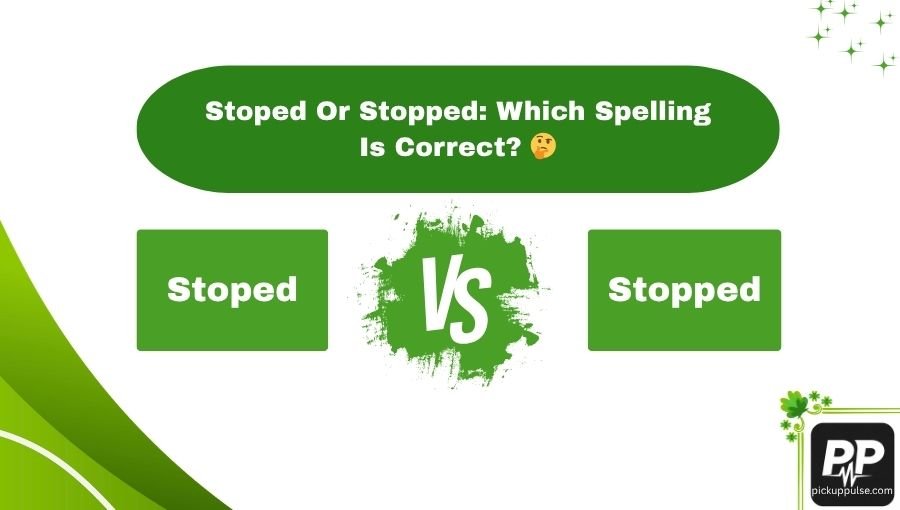
Stoped Or Stopped is one of the most common spelling confusions in English grammar, and many writers accidentally mix up these two forms when writing quickly. At first glance, they may look almost identical, but only one of them is correct in standard English. The correct form is often misunderstood because English spelling rules about doubling consonants can feel confusing, especially for beginners and even fluent speakers.
If you have ever typed a sentence like “The car stoped suddenly” and felt unsure, you are definitely not alone. This small spelling difference creates big confusion in emails, assignments, and everyday writing. The reason lies in a simple grammar rule that determines when a consonant must be doubled before adding “-ed.”
In this article, you will clearly understand why “stopped” is correct, why “stoped” is wrong, and how to avoid this mistake forever. You will also learn practical examples, grammar rules, and memory tricks that make the concept easy to remember. 📚
Quick Answer: Stoped Or Stopped ✅
The correct spelling is “stopped.”
The word “stoped” is incorrect in standard English grammar.
“Stopped” is the past tense and past participle form of the verb “stop.” Because “stop” follows a consonant-vowel-consonant (CVC) pattern, the final consonant p must be doubled before adding -ed.
✔ Correct: She stopped talking.
❌ Incorrect: She stoped talking.
Understanding the Basics of Stoped Or Stopped
The confusion between stoped and stopped comes from English spelling rules related to verb endings.
When a short verb ends in:
- consonant + vowel + consonant
- and the final syllable is stressed,
the last consonant is usually doubled before adding -ed or -ing.
The verb stop follows this rule.
Comparison Table: Stoped Or Stopped
| Form | Type | Meaning | Example | Correct/Incorrect |
|---|---|---|---|---|
| Stoped | Misspelling | Incorrect version of “stopped” | “He stoped running.” | ❌ Incorrect |
| Stopped | Verb (past tense) | Ceased movement or action | “He stopped running.” | ✅ Correct |
Correct Meanings & Uses of “Stopped” ✍️
“Stopped” as the Past Tense of Stop
“Stopped” means that an action ended in the past.
Examples
- The bus stopped at the station.
- She stopped laughing after hearing the news.
- We stopped working at 6 PM.
Sentence Breakdown
Example:
The bus stopped at the station.
- The bus = subject
- stopped = past tense verb
- at the station = location phrase
This sentence shows an action completed in the past.
“Stopped” as a Past Participle
“Stopped” can also work with helping verbs like:
- has
- have
- had
- was
- were
Examples
- The rain has stopped.
- He had stopped speaking.
- Traffic was stopped for hours.
“Stopped” in Continuous Action Contexts
Sometimes “stopped” describes an interruption.
Examples
- She stopped me from leaving.
- They stopped the project due to budget cuts.
In these examples, the word means to prevent or end something.
Test Tip ✅
A quick way to test the correct spelling:
Ask yourself:
Does the verb end with consonant-vowel-consonant?
For “stop”:
- s = consonant
- t = consonant
- o = vowel
- p = consonant
Since it ends in a CVC pattern and is a short stressed word, double the final consonant.
✔ stop → stopped
✔ stop → stopping
Why “Stoped” Is Incorrect ❌
The spelling “stoped” breaks standard English spelling rules.
English grammar requires doubling the final consonant when adding -ed to certain short verbs.
Correct Pattern
| Base Verb | Correct Past Tense |
|---|---|
| Stop | Stopped |
| Plan | Planned |
| Drop | Dropped |
| Shop | Shopped |
Incorrect Pattern
| Incorrect Form | Why It Is Wrong |
|---|---|
| Stoped | Missing doubled consonant |
| Planed | Different meaning from “planned” |
| Droped | Incorrect spelling |
Grammar Rules Behind “Stopped” 📖
According to standard English grammar references such as Merriam-Webster and traditional spelling conventions, verbs that end in a short vowel followed by a single consonant often double the consonant before adding suffixes like:
- -ed
- -ing
The verb “stop” fits this rule perfectly.
The Consonant Doubling Rule
Formula
Short vowel + single consonant = double the consonant
Example:
- stop → stopped
- run → running
- hop → hopped
Why English Uses Double Consonants
Doubling the consonant helps preserve pronunciation.
Compare:
| Word | Pronunciation |
|---|---|
| Hoping | Long “o” sound |
| Hopping | Short “o” sound |
Without the extra consonant, pronunciation patterns can change.
Case Study: Real-Life Workplace Example 💼
Imagine an employee sending this email:
❌ Incorrect Email:
“The production line stoped working yesterday.”
This sentence contains a spelling error that may look unprofessional.
Correct Version
✔ Correct Email:
“The production line stopped working yesterday.”
This corrected version follows proper grammar rules and creates a more polished impression.
Why This Matters in Professional Communication
In workplaces, small spelling errors can:
- reduce credibility
- create confusion
- affect professionalism
- weaken written communication
Correct grammar improves trust and clarity.
Common Mistakes People Make 🚫
Many people accidentally write “stoped” instead of “stopped.”
Here are the most common reasons.
1. Fast Typing
People often skip the extra “p” while typing quickly.
Example:
- Intended: stopped
- Typed: stoped
2. Autocorrect Errors
Sometimes autocorrect misses grammar-based spelling mistakes.
3. Lack of Grammar Knowledge
Many writers do not fully understand consonant doubling rules.
4. Influence of Other Verbs
Some verbs do not double the consonant.
Examples:
- open → opened
- listen → listened
This inconsistency confuses learners.
Similar Grammar Confusions Table 📋
| Incorrect | Correct | Explanation |
|---|---|---|
| Stoped | Stopped | Double consonant needed |
| Your | You’re | Possession vs contraction |
| Its | It’s | Possession vs “it is” |
| Planed | Planned | Different meanings |
| Droped | Dropped | Double consonant needed |
| Runing | Running | Double consonant needed |
Usage in Different Contexts 🌎
Everyday Conversation
People commonly use “stopped” in casual speech.
Examples
- I stopped eating sugar.
- She stopped by my house yesterday.
- They stopped arguing.
Professional Writing
Correct spelling is especially important in business settings.
Examples
- The system stopped responding.
- Sales stopped increasing last quarter.
- The meeting stopped at noon.
Professional writing should always use “stopped.”
Creative Writing
Authors use “stopped” to describe action, emotion, or tension.
Example
“He stopped at the old bridge and stared into the fog.”
This creates atmosphere and movement in storytelling.
Social Media and Texting 📱
Even informal communication benefits from correct spelling.
Examples
- “I stopped watching that show.”
- “Traffic finally stopped 😩”
Good spelling improves readability online.
Why It Matters ✨
Some people think small spelling mistakes are unimportant. However, correct grammar has a major impact on communication.
1. Clarity in Communication
Correct spelling helps readers understand your meaning instantly.
Example:
✔ “The machine stopped.”
❌ “The machine stoped.”
The second version may distract readers.
2. Professionalism
Good grammar creates a stronger impression.
Employers, teachers, and clients often judge writing quality quickly.
3. Digital Communication Accuracy
Online communication happens fast. Clear writing prevents misunderstandings.
Correct spelling also helps with:
- SEO content
- business emails
- academic writing
- customer communication
Inspirational Quote 💡
“Good writing is clear thinking made visible.”
This reminds us that proper grammar improves how ideas are shared.
Special Exceptions ⚠️
In standard English, “stoped” is not accepted as the correct past tense of “stop.”
However, there are rare situations where unusual spellings may appear:
- usernames
- brand names
- creative stylization
- fictional content
Example:
- “Stoped Studios”
- “STOPED Gaming”
These are intentional naming choices, not correct grammar forms.
Detailed Rule Comparison: When to Double Consonants
Understanding the broader rule can help you avoid similar mistakes.
Double the Final Consonant When:
| Condition | Example |
|---|---|
| One syllable verb | stop |
| Ends in consonant-vowel-consonant | sto-p |
| Stress on final syllable | prefer → preferred |
Do NOT Double the Consonant When:
| Condition | Example |
|---|---|
| Verb ends in two vowels | rain → rained |
| Final consonant not preceded by short vowel | need → needed |
| Stress not on final syllable | open → opened |
More Examples of Correct Verb Doubling ✅
| Base Verb | Correct Form |
|---|---|
| Stop | Stopped |
| Drop | Dropped |
| Hug | Hugged |
| Plan | Planned |
| Jog | Jogged |
| Rub | Rubbed |
More Examples Without Doubling ❌
| Base Verb | Correct Form |
|---|---|
| Open | Opened |
| Visit | Visited |
| Listen | Listened |
| Rain | Rained |
| Clean | Cleaned |
Pronunciation Guide 🔊
The word “stopped” is pronounced:
/stɒpt/ or /stɑːpt/
The double “p” is not strongly pronounced separately, but it affects spelling and vowel structure.
Memory Tricks to Remember “Stopped” 🧠
Trick #1: Think of “Hop → Hopped”
If “hop” becomes “hopped,” then “stop” becomes “stopped.”
Trick #2: Short Word = Double Consonant
Many short verbs double the final consonant.
Examples:
- stop → stopped
- clap → clapped
- grab → grabbed
Trick #3: Hear the Short Vowel Sound
The short “o” sound in “stop” signals consonant doubling.
Quick Recap Checklist ✅
| Question | If Yes → Use |
|---|---|
| Is the base verb “stop”? | Stopped |
| Are you writing past tense? | Stopped |
| Does the verb follow CVC pattern? | Double consonant |
| Is “stoped” in your sentence? | Correct it |
Practice Examples
Example 1
❌ She stoped crying.
✔ She stopped crying.
Example 2
❌ The train stoped suddenly.
✔ The train stopped suddenly.
Example 3
❌ We stoped at the hotel.
✔ We stopped at the hotel.
Frequently Asked Questions (FAQs) ❓
Is “stoped” ever correct?
No. “Stoped” is not considered correct in standard English grammar. The proper spelling is “stopped.”
Why does “stopped” have two p’s?
The word follows the consonant-vowel-consonant spelling rule. Short verbs ending in this pattern usually double the final consonant before adding “-ed.”
Is “stopped” a past tense verb?
Yes. “Stopped” is the past tense and past participle form of the verb “stop.”
How can I remember the correct spelling?
Remember this simple pattern:
- stop → stopped
- hop → hopped
- drop → dropped
Short verbs often double the final consonant.
Does autocorrect always catch “stoped”?
Not always. Some spell-check tools may miss it, especially in casual writing platforms.
Is “stopping” spelled with two p’s too?
Yes. The correct spelling is:
✔ stopping
❌ stoping
The same consonant-doubling rule applies.
Additional Examples for Better Understanding 📘
Past Tense Examples
- The teacher stopped the lesson early.
- Rain stopped after midnight.
- My phone stopped charging.
Past Participle Examples
- The music has stopped.
- They had stopped arguing before dinner.
- Traffic was stopped by police.
Mini Grammar Exercise 📝
Choose the correct word.
1. The dog ______ barking.
- stoped
- stopped
✔ Answer: stopped
2. We ______ at the gas station.
- stoped
- stopped
✔ Answer: stopped
3. The machine suddenly ______ working.
- stoped
- stopped
✔ Answer: stopped
SEO and Writing Importance of Correct Spelling 🌐
Correct spelling affects more than grammar.
It also impacts:
- search engine rankings
- readability
- trustworthiness
- user experience
Misspelled words can reduce content quality and make articles look less reliable.
For bloggers, businesses, and students, accurate grammar matters greatly.
Educational Insight: Why English Learners Struggle
English learners often struggle with spelling because English contains many irregular patterns.
The confusion increases because:
- some verbs double consonants
- some do not
- pronunciation and spelling do not always match
Consistent practice improves accuracy over time.
Expert Writing Advice ✨
When editing your writing:
✅ Check short verbs carefully
✅ Watch for doubled consonants
✅ Use grammar tools wisely
✅ Read sentences aloud
✅ Proofread before publishing
These habits improve writing quality significantly.
Conclusion
The debate between “stoped or stopped” has a very clear answer: “stopped” is the only correct spelling in standard English grammar. The word follows the consonant-vowel-consonant rule, which requires doubling the final consonant before adding “-ed.”
While “stoped” may appear in typing mistakes or informal online content, it is grammatically incorrect and should be avoided in professional, academic, and everyday writing.
Understanding this simple grammar rule can help you avoid many similar spelling mistakes. It also improves clarity, professionalism, and confidence in communication. Whether you are writing an email, text message, essay, or social media post, using the correct form matters.
The next time you hesitate between “stoped” and “stopped,” remember this easy rule:
Short verbs like “stop” double the final consonant before adding endings.
And that is why the correct spelling will always be “stopped.” ✅
Also Read This: Protestors or Protesters

Hi, I’m Zyler Knox, an expert in names and unique nickname creation. I specialize in developing fresh, modern, and expressive nicknames that add personality to every name.