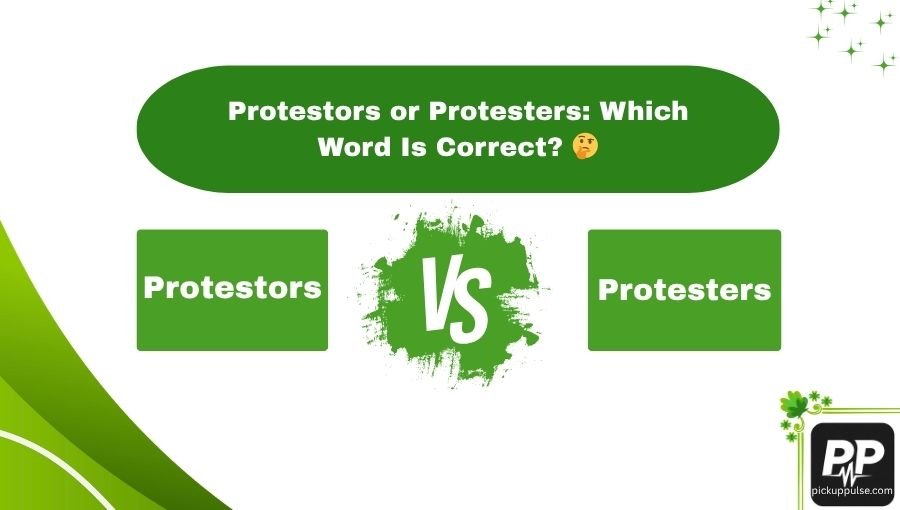
Protestors or Protesters: Which Word Is Correct? 🤔
Language can be tricky, especially when two words look almost identical and seem to mean the same thing. One common confusion in English writing is “protestors or protesters.” You may have seen both spellings in newspapers, social media posts, blogs, or even official documents. So, which one is actually correct? 📝
The short answer is simple: “Protesters” is the standard and widely accepted spelling in modern English. However, “protestors” also appears occasionally, which creates confusion for writers, students, and professionals alike.
Understanding the difference matters because spelling affects clarity, professionalism, and credibility. Whether you are writing an article, sending an email, posting online, or preparing academic work, using the correct form can improve your communication instantly.
In this detailed guide, you will learn:
- The correct spelling
- Why confusion happens
- Grammar rules behind the words
- Real-world examples
- Common mistakes to avoid
- Usage tips for different contexts
- FAQs and quick practice checks
By the end, you will confidently know when to use protesters and why it is usually the better choice. 🚀
Quick Answer: Protestors or Protesters ✅
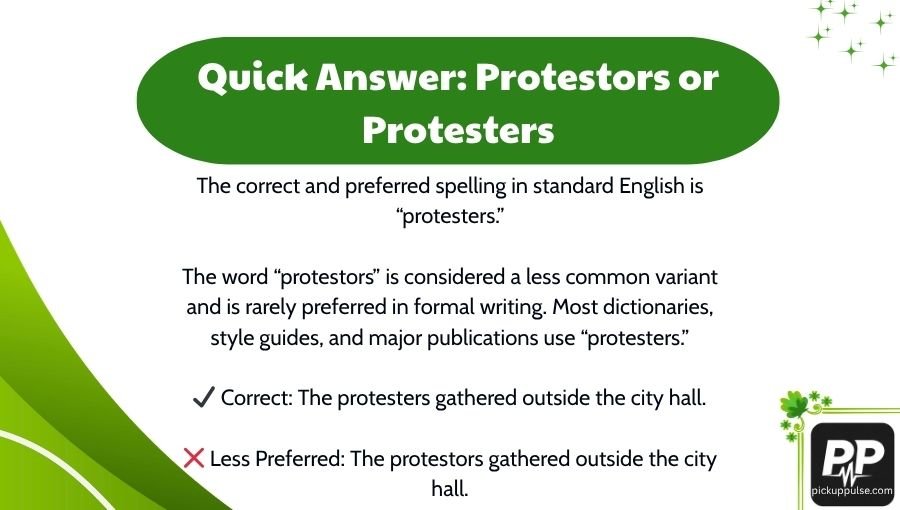
The correct and preferred spelling in standard English is “protesters.”
The word “protestors” is considered a less common variant and is rarely preferred in formal writing. Most dictionaries, style guides, and major publications use “protesters.”
✔ Correct: The protesters gathered outside the city hall.
❌ Less Preferred: The protestors gathered outside the city hall.
Understanding the Basics of Protestors or Protesters
Both words come from the verb “protest,” which means to express disagreement, objection, or opposition. The confusion comes from the different noun endings: -er and -or.
In English grammar, many people who perform actions are described using the -er ending:
- teach → teacher
- work → worker
- protest → protester
Although “protestor” exists, “protester” follows the more common English word formation pattern.
Comparison Table: Protestors vs Protesters
| Form | Type | Meaning | Example | Correct/Incorrect |
|---|---|---|---|---|
| Protesters | Noun | People who protest | The protesters marched peacefully. | ✅ Correct |
| Protestors | Variant noun | Same meaning but less common | The protestors gathered downtown. | ⚠ Less Preferred |
Correct Meanings and Uses
What Does “Protesters” Mean? 📢
The word “protesters” refers to people who publicly express opposition or disagreement, often during demonstrations, marches, or rallies.
Example Sentences
- The protesters demanded environmental reforms.
- “Protesters” refers to people participating in a protest.
- Thousands of protesters filled the streets peacefully.
- The noun identifies a group demonstrating publicly.
- Student protesters organized a campus rally.
- Describes students involved in activism.
Sentence Breakdown
| Part | Explanation |
|---|---|
| The | Article |
| protesters | Noun |
| demanded | Verb |
| environmental reforms | Object |
Test Tip 💡
If the word refers to people taking action through protest, use “protesters.”
What Does “Protestors” Mean?
“Protestors” technically carries the same meaning. However, it is much less common in modern English usage.
Some older texts or regional publications may still use it, but major style guides strongly favor “protesters.”
Example
⚠ Less Common:
The protestors stood outside the courthouse.
✅ Preferred:
The protesters stood outside the courthouse.
Test Tip 💡
If you are unsure which spelling to choose, always select “protesters.” It is safer and more professional.
Why “Protesters” Is Preferred
The ending -er is the standard English suffix for someone who performs an action.
Examples include:
| Verb | Standard Noun |
|---|---|
| Teach | Teacher |
| Write | Writer |
| Sing | Singer |
| Protest | Protester |
The -or ending usually appears in words derived from Latin roots:
| Word | Origin |
|---|---|
| Actor | Latin |
| Doctor | Latin |
| Creator | Latin |
Since “protest” forms naturally with -er, “protester” became the dominant spelling.
Case Study Section 📚
Workplace Email Example
Imagine an editor reviewing a news article.
Original Draft
“Several protestors gathered outside the office building.”
The editor changes it to:
“Several protesters gathered outside the office building.”
Why?
Because:
- “Protesters” matches standard newsroom style.
- It aligns with dictionaries and grammar authorities.
- Readers recognize it instantly.
Real-Life Media Usage
Major organizations use “protesters” almost exclusively:
- The New York Times
- BBC
- CNN
- Reuters
- Associated Press
This widespread usage reinforces the preferred spelling in professional communication.
Grammar Rules Explanation ✍️
According to Merriam-Webster and other major dictionaries, both forms exist, but “protester” is the dominant and standard spelling.
Why the “-er” Ending Works Better
English commonly uses -er to create nouns meaning “a person who performs an action.”
Examples
| Verb | Noun |
|---|---|
| Run | Runner |
| Speak | Speaker |
| Drive | Driver |
| Protest | Protester |
The pattern feels natural to English speakers, which is why “protester” became more accepted.
Why “Protestor” Exists
Some nouns use -or endings because of historical Latin influence. Over time, some writers applied that pattern to “protestor,” but it never became the dominant form.
Grammar Authority Reference 📖
Merriam-Webster lists:
- Protester → primary form
- Protestor → variant spelling
This means “protester” is the safest and most widely accepted option.
Common Mistakes 🚫
People often confuse “protestors” and “protesters” because both appear online. Fast reading and autocorrect also contribute to mistakes.
Why These Mistakes Happen
1. Fast Typing ⌨️
Writers may accidentally choose the wrong ending without noticing.
2. Autocorrect
Some devices fail to flag “protestor” because it technically exists.
3. Lack of Knowledge
Many people assume both forms are equally standard.
Similar Grammar Confusions Table
| Confusing Pair | Correct Usage | Common Error |
|---|---|---|
| It’s / Its | It’s = it is | Mixing possession and contraction |
| Your / You’re | You’re = you are | Apostrophe confusion |
| Their / There / They’re | Different meanings | Homophone confusion |
| Affect / Effect | Verb vs noun | Misunderstanding grammar roles |
| Protesters / Protestors | Protesters preferred | Variant spelling confusion |
Usage in Different Contexts 🌍
Everyday Conversation
In casual speech, pronunciation sounds nearly identical, so confusion rarely matters verbally.
Example
“The protesters blocked the road during the march.”
Professional Writing
Professional and academic writing should strongly prefer “protesters.”
Best Practice
✔ Use “protesters” in:
- News reports
- Essays
- Research papers
- Business communication
Creative Writing
Fiction writers may occasionally use “protestors” for stylistic or character reasons, but “protesters” still feels more natural.
Example
“The weary protesters carried signs through the rain.”
Social Media and Texting 📱
Online posts sometimes contain inconsistent spelling.
Common Social Media Examples
❌ “Protestors are downtown.”
✅ “Protesters are downtown.”
Because social media spreads language quickly, incorrect or uncommon forms often become more visible.
Why It Matters ⭐
Correct spelling improves communication in powerful ways.
1. Clarity
Readers instantly understand standard spelling.
2. Professionalism
Correct grammar creates trust and credibility.
3. Digital Communication Accuracy
Search engines, grammar tools, and professional editors favor standard forms.
4. Better Academic Writing
Using accepted spelling improves essays and reports.
Short Quote 💬
“Clear writing reflects clear thinking.”
Even one spelling choice can affect how readers perceive your writing.
Special Exception ⚠️
Although “protesters” is preferred, there are a few rare exceptions.
Brand or Publication Style
Some organizations or older publications may intentionally use “protestor” because:
- It matches internal style rules
- It reflects historical usage
- It appears in archived material
Direct Quotes
If a source originally uses “protestors,” you should preserve the spelling in direct quotations.
Example
The original flyer stated, “All protestors must remain peaceful.”
In this case, changing the word would alter the quote.
Quick Recap Checklist ✅
Which Form Should You Use?
| Question | If Yes → Use |
|---|---|
| Are you writing professionally? | Protesters |
| Are you following modern grammar standards? | Protesters |
| Are you unsure which is correct? | Protesters |
| Are you quoting original text using “protestors”? | Protestors |
| Do you want the safest spelling choice? | Protesters |
Practice Examples 🧠
Example 1
Thousands of ______ marched through the city.
✅ Correct Answer: protesters
Example 2
The newspaper interviewed several ______ after the rally.
✅ Correct Answer: protesters
Example 3
The archived document referred to the demonstrators as ______.
✅ Acceptable in historical quote: protestors
Frequently Asked Questions (FAQs) ❓
Is “protestors” wrong?
Not completely. “Protestors” is a recognized variant spelling, but “protesters” is much more common and widely preferred.
Which spelling should I use in formal writing?
Use “protesters.” It is the standard spelling in journalism, academia, and professional communication.
Why do some people still use “protestors”?
Some writers follow older patterns or personal preference. In some cases, publications keep historical spelling traditions.
Do dictionaries recognize both words?
Yes. Major dictionaries usually list both forms, but they identify “protester” as the primary spelling.
Is “protester” American or British English?
“Protester” is standard in both American English and British English.
Can I use “protestors” in creative writing?
Yes, but it may appear less polished or less modern. “Protesters” is still the stronger choice for readability.
SEO Insights: Why Searchers Ask “Protestors or Protesters” 🔍
Many users search this phrase because:
- They see both spellings online
- Spellcheck tools give mixed results
- News articles differ occasionally
- They want professional accuracy
Search engines typically prioritize pages using “protesters” because it aligns with common usage and authority sources.
Expert Writing Tips ✨
Always Follow Style Guides
If you write professionally, follow:
- AP Style
- Chicago Manual of Style
- Merriam-Webster preferences
All strongly favor “protesters.”
Use Grammar Tools Carefully
Spellcheck tools are helpful but not perfect. Always verify with trusted dictionaries.
Read Reputable Sources
Notice how major publications consistently use:
✔ protesters
Exposure to correct usage strengthens writing habits naturally.
Historical Evolution of the Word 📜
The word “protest” comes from Latin and Old French roots related to declaring or publicly affirming something.
As English evolved, the noun form gradually settled into “protester.”
Language changes over time, and variant spellings occasionally survive even after one version becomes dominant.
This explains why “protestor” still appears occasionally despite being less common.
Linguistic Perspective 🧠
From a linguistic standpoint, English often simplifies patterns over time.
The -er ending is:
- More productive
- More recognizable
- Easier for native speakers to process
That is why modern English naturally favors:
- teacher
- runner
- writer
- protester
Instead of irregular alternatives.
Media and Journalism Preferences 📰
Professional journalism values consistency.
News organizations almost always standardize language choices to maintain credibility and readability.
Common Headline Examples
✅ “Protesters gather outside parliament.”
✅ “Police monitor peaceful protesters.”
Rarely:
⚠ “Protestors gather outside parliament.”
This consistent usage reinforces public understanding.
Academic Writing Recommendations 🎓
Students should always choose “protesters” in:
- Essays
- Research papers
- Reports
- Thesis writing
Professors and editors expect standard spelling conventions.
Using uncommon variants may distract readers or appear careless.
Digital Writing and SEO Considerations 💻
For online content, using the dominant spelling matters because:
- Readers trust familiar wording
- Search engines recognize common usage
- AI writing systems favor standard patterns
If you are optimizing content for Google or AI search systems, “protesters” performs better naturally.
Final Comparison Summary 📌
| Feature | Protesters | Protestors |
|---|---|---|
| Standard English | ✅ Yes | ⚠ Rare |
| Common in Journalism | ✅ Yes | ❌ Rare |
| Academic Acceptance | ✅ High | ⚠ Limited |
| Dictionary Recognition | ✅ Primary | ✅ Variant |
| Best Choice Overall | ✅ Yes | ❌ Usually No |
Conclusion 🎯
The debate around “protestors or protesters” is simpler than it first appears. While both spellings technically exist, “protesters” is the clear standard in modern English. It is the preferred form in journalism, academic writing, professional communication, and everyday usage.
Choosing the correct spelling improves clarity, professionalism, and reader trust. Since English commonly forms action nouns with the -er ending, “protester” fits naturally alongside words like “teacher,” “writer,” and “speaker.”
Although “protestor” may still appear occasionally in historical texts or specific quotations, it is not the best choice for most writers today.
When in doubt, remember this simple rule:
✅ Use “protesters” for modern, correct, and professional English.
Clear language creates strong communication — and strong communication leaves a lasting impression. 🚀
Also Read This: What Does SS Mean in Text

Hi, I’m Daxter Wilde, an expert in names who enjoys designing creative and distinctive nicknames. My goal is to turn simple names into something fun, memorable, and full of character.