Envolved or Involved: Which Word Is Correct? 🤔
Have you ever been confused between envolved or involved while writing a sentence and wondered which one is correct? This is a very common English mistake, especially when typing quickly or relying on autocorrect. Many people mistakenly write “envolved,” thinking it is a valid alternative, but in standard English grammar, only one form is correct.
The confusion around envolved or involved happens because both sound similar when spoken, and spelling errors often go unnoticed in casual writing. However, using the wrong form can make your writing look unprofessional in emails, assignments, or business communication.
Understanding the correct usage of envolved or involved is important if you want to improve your grammar accuracy and writing confidence. In this guide, you will clearly learn the correct spelling, meaning, grammar rules, and real-life examples so you never make this mistake again. ✍️
By the end, you will fully understand why envolved or involved is not a real choice — and which one you should always use.
Quick Answer: Envolved or Involved ✅
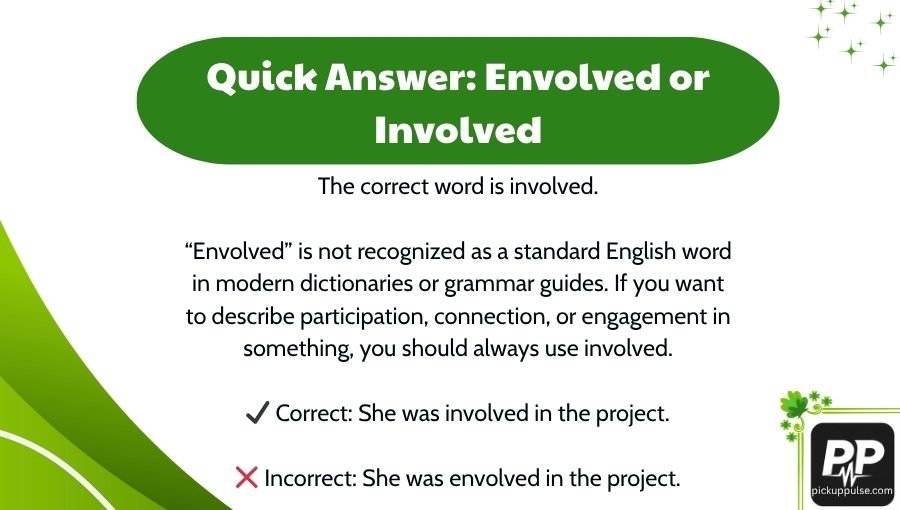
The correct word is involved.
“Envolved” is not recognized as a standard English word in modern dictionaries or grammar guides. If you want to describe participation, connection, or engagement in something, you should always use involved.
✔ Correct: She was involved in the project.
❌ Incorrect: She was envolved in the project.
Understanding the Basics of Envolved or Involved
The confusion between envolved or involved mainly comes from spelling mistakes and pronunciation habits. Let’s simplify it clearly.
What Does “Involved” Mean?
The word involved means:
- Taking part in something
- Being connected to something
- Being included in an activity or situation
It is the past tense and past participle form of the verb “involve.”
Examples:
- He was involved in the meeting.
- They became involved in community service.
- She is deeply involved with the organization.
Is “Envolved” a Real Word?
No. ❌
“Envolved” is considered a misspelling of “involved.” It does not appear in standard English dictionaries like:
- Merriam-Webster
- Oxford English Dictionary
- Cambridge Dictionary
If you use “envolved” in formal writing, it will usually be marked as incorrect by spell-check tools.
Comparison Table: Envolved or Involved
| Form | Type | Meaning | Example | Correct or Incorrect |
|---|---|---|---|---|
| Involved | Verb/Adjective | Connected, included, participating | She was involved in the event. | ✅ Correct |
| Envolved | Misspelling | No accepted meaning in English | He was envolved in the case. | ❌ Incorrect |
Correct Meanings and Uses of “Involved” 📚
“Involved” as a Verb
“Involved” is commonly used as the past tense of “involve.”
Example:
- The manager involved the whole team in the decision.
Sentence Breakdown:
- Manager = subject
- Involved = action verb
- Whole team = object
This means the manager included the team.
“Involved” as an Adjective
“Involved” can also describe someone who actively participates in something.
Example:
- She is very involved in charity work.
This means she actively participates in charity activities.
“Involved” for Emotional Connections
The word may also describe emotional or romantic attachment.
Example:
- They became emotionally involved.
This indicates a close emotional connection.
Test Tip ✅
If you are unsure whether to use “involved,” ask yourself:
“Am I talking about participation, connection, or inclusion?”
If yes, then “involved” is probably correct.
Why “Envolved” Is Incorrect ❌
The word “envolved” does not follow the accepted spelling pattern of the English verb “involve.”
The correct root word is:
- Involve
NOT:
- ❌ Envolve
Because the base verb is “involve,” the past tense naturally becomes:
- Involved
English grammar relies heavily on standardized spelling. Even if a wrong word sounds acceptable, dictionaries determine official usage.
Grammar Rules Behind “Involved”
The Root Verb Rule
English verbs form past tense using predictable patterns.
Base Verb:
- Involve
Past Tense:
- Involved
Past Participle:
- Involved
Examples:
- Present: I involve my team.
- Past: I involved my team.
- Perfect: I have involved my team.
Why People Type “Envolved”
There are several reasons:
1. Pronunciation Confusion
Some accents soften the “i” sound, making “involved” sound closer to “envolved.”
2. Fast Typing ⌨️
People type quickly and accidentally swap letters.
3. Autocorrect Problems
Sometimes autocorrect fails to catch uncommon spelling errors.
4. Influence from Other Languages
Certain languages use prefixes similar to “en-,” leading learners to assume “envolved” exists.
Case Study: Workplace Email Example 💼
Imagine an employee writing this email:
❌ Incorrect Version:
“I was heavily envolved in the marketing campaign.”
A manager reading this may notice the spelling error immediately. Even though the meaning is understandable, the mistake can reduce professionalism.
✔ Correct Version:
“I was heavily involved in the marketing campaign.”
The corrected sentence looks polished, professional, and grammatically accurate.
Real-Life Conversation Examples
Everyday Conversation
✔ Correct:
- “Are you involved in the school event?”
- “He became involved after the discussion.”
❌ Incorrect:
- “Are you envolved in the school event?”
Professional Writing
✔ Correct:
- “Several departments were involved in the project.”
❌ Incorrect:
- “Several departments were envolved in the project.”
Academic Writing
✔ Correct:
- “Researchers involved in the study collected extensive data.”
Social Media and Texting 📱
People sometimes type quickly online and make mistakes like:
❌ “I’m so envolved in this drama lol.”
Even in casual texting, using the correct spelling improves clarity.
✔ “I’m so involved in this drama lol.”
Common Mistakes Related to Envolved or Involved 🚨
Many grammar mistakes happen because words sound similar.
Here are some common examples:
| Incorrect | Correct |
|---|---|
| Envolved | Involved |
| Its | It’s |
| Your | You’re |
| Their | They’re |
| Loose | Lose |
| Then | Than |
Why These Mistakes Happen
Fast Typing
People prioritize speed over accuracy.
Autocorrect Dependence
Writers trust technology too much.
Lack of Grammar Knowledge
Many users never learn the grammatical rules behind the words.
Similar Pronunciation
English contains many confusing sound patterns.
Standard Grammar Authority Explanation 📖
According to grammar authorities such as Merriam-Webster and Cambridge Dictionary, the correct word is “involved.”
The verb “involve” originates from Latin roots connected to wrapping, including, or engaging something.
There is no officially accepted verb “envolve” in modern English grammar.
Therefore:
- involve → involved ✅
- envolve → envolved ❌
Usage of “Involved” in Different Contexts 🌎
1. Everyday Communication
People commonly use “involved” when talking about activities and participation.
Examples:
- “My parents were involved in my education.”
- “She likes getting involved in local events.”
2. Professional Writing
In business settings, “involved” often describes responsibility or collaboration.
Examples:
- “Everyone involved must sign the agreement.”
- “The finance department was involved in budgeting.”
Professional writing requires correct spelling because mistakes may affect credibility.
3. Creative Writing
Authors use “involved” to describe emotional or complex situations.
Example:
- “The plot became increasingly involved as secrets emerged.”
Here, “involved” means complicated or intricate.
4. Social Media Usage
On social platforms, spelling errors spread quickly because users type informally.
Still, proper spelling improves readability and professionalism.
✔ Better:
- “I’m deeply involved in this fandom.”
❌ Incorrect:
- “I’m deeply envolved in this fandom.”
Why Correct Usage Matters ✨
1. Clear Communication
Correct grammar helps readers understand your meaning instantly.
2. Professional Image
Employers, teachers, and clients often judge writing quality.
A simple spelling mistake may appear careless.
3. Academic Accuracy
Students lose marks for grammar and spelling errors.
4. Better Digital Communication
Online communication moves fast. Correct spelling reduces misunderstandings.
Short Quote 💬
“Good grammar is credibility in written form.”
Special Exception ⚠️
There are almost no accepted exceptions where “envolved” is considered correct in English grammar.
However, you may occasionally see:
- Typos online
- Usernames
- Fictional brand names
- Non-English spellings
Even so, these do not make “envolved” grammatically correct in standard English.
Deep Grammar Breakdown of “Involved”
Verb Structure
Base Form:
- Involve
Present Participle:
- Involving
Past Tense:
- Involved
Past Participle:
- Involved
Example Sentences by Tense
| Tense | Example |
|---|---|
| Present | I involve my team in decisions. |
| Past | I involved my team yesterday. |
| Future | I will involve everyone tomorrow. |
| Present Perfect | I have involved the staff already. |
Synonyms of “Involved”
Here are some similar words depending on context:
| Synonym | Meaning |
|---|---|
| Included | Part of something |
| Engaged | Actively participating |
| Connected | Linked to something |
| Associated | Related to something |
| Participating | Taking part |
Antonyms of “Involved”
| Antonym | Meaning |
|---|---|
| Detached | Not connected |
| Uninvolved | Not participating |
| Separate | Independent |
| Disconnected | Not linked |
Memory Tricks to Remember the Correct Word 🧠
Trick #1: Think of the Root Word
The word starts with:
- Involve
So the past form must be:
- Involved
Trick #2: Remember “IN” Means Included
The prefix “in” can help you remember inclusion and participation.
- involved = included
Trick #3: Use Spell Check
Modern writing tools usually underline “envolved” as incorrect.
Common Sentence Patterns with “Involved”
Pattern 1: Involved in
✔ Correct:
- “She is involved in politics.”
Pattern 2: Get Involved
✔ Correct:
- “You should get involved in volunteering.”
Pattern 3: Become Involved
✔ Correct:
- “They became involved in the discussion.”
Pattern 4: Emotionally Involved
✔ Correct:
- “He became emotionally involved.”
Advanced Usage of “Involved”
Sometimes “involved” means complicated rather than simply connected.
Example:
- “The instructions were very involved.”
Meaning:
- The instructions were complex or detailed.
This usage is less common but still correct.
Quick Recap Checklist ✅
| Question | If Yes → Use |
|---|---|
| Are you talking about participation? | Involved |
| Are you describing connection or inclusion? | Involved |
| Are you writing formal English? | Involved |
| Are you tempted to type “envolved”? | Don’t — use involved |
Practice Examples
Example 1
❌ She was envolved in the case.
✔ She was involved in the case.
Example 2
❌ Everyone envolved attended the meeting.
✔ Everyone involved attended the meeting.
Example 3
❌ He became emotionally envolved.
✔ He became emotionally involved.
Mini Quiz 📝
Choose the correct sentence.
1.
A. She was envolved in the program.
B. She was involved in the program.
✔ Correct Answer: B
2.
A. Everyone involved signed the form.
B. Everyone envolved signed the form.
✔ Correct Answer: A
3.
A. He became emotionally involved.
B. He became emotionally envolved.
✔ Correct Answer: A
FAQs About Envolved or Involved
1. Is “envolved” ever correct?
No. “Envolved” is not considered a correct English word in standard grammar.
2. Why do people type “envolved”?
People often confuse the spelling because of pronunciation, fast typing, or lack of grammar knowledge.
3. What does “involved” mean?
“Involved” means connected, included, engaged, or participating in something.
4. Is “involved” a verb or adjective?
It can be both.
Verb:
- “She involved the team.”
Adjective:
- “She is involved in the project.”
5. How can I remember the correct spelling?
Remember the base word:
- involve → involved
There is no standard English verb called “envolve.”
6. Can spelling mistakes affect professionalism?
Yes. Grammar and spelling errors can negatively affect academic, business, and professional communication.
SEO Summary Snippet 📌
Envolved or Involved — Which Is Correct?
The correct word is involved. “Envolved” is a misspelling and is not recognized in standard English dictionaries. Use “involved” when describing participation, connection, or inclusion in something.
Final Thoughts on Envolved or Involved ✨
The confusion between envolved or involved is understandable, especially in fast digital communication. However, standard English grammar recognizes only one correct spelling: involved.
Whether you are writing emails, academic papers, workplace reports, or social media captions, using the correct word improves clarity, professionalism, and credibility. Small grammar mistakes may seem harmless, but they can affect how readers perceive your writing.
The easiest way to remember the rule is simple:
The base verb is “involve,” so the correct form is always “involved.”
There is no accepted English word called “envolved.” ❌
By practicing correct spelling and paying attention to grammar details, you can communicate more confidently and effectively in every situation. Great writing starts with small, accurate choices — and choosing “involved” is one of them. 🚀
Also Read This: Evil Eye Bracelet Meaning

Hi, I’m Tavian Cross, an expert in names and the art of creating meaningful, stylish, and memorable nicknames. I focus on crafting original name ideas that feel personal, creative, and easy to connect with.