Pre vs Post: What’s the Difference and How to Use Them Correctly ✍️
Have you ever been unsure whether to use pre vs post when writing a sentence? This small grammar choice can change the meaning of your message, yet many people mix them up. These two prefixes appear in emails, academic writing, business communication, and even everyday texting, which makes them both common and confusing.
The confusion around pre vs post usually comes from how similar they look and how easily they attach to other words. Should it be pre-meeting or post-meeting? Pre-launch or post-launch? Even experienced writers sometimes hesitate when choosing between them.
Understanding pre vs post is important for clear and professional communication. Once you learn the simple rule behind them, your writing becomes more accurate and much easier to read. In this guide, we’ll break everything down in a clear and practical way so you never second-guess them again.
Quick Answer: Pre vs Post
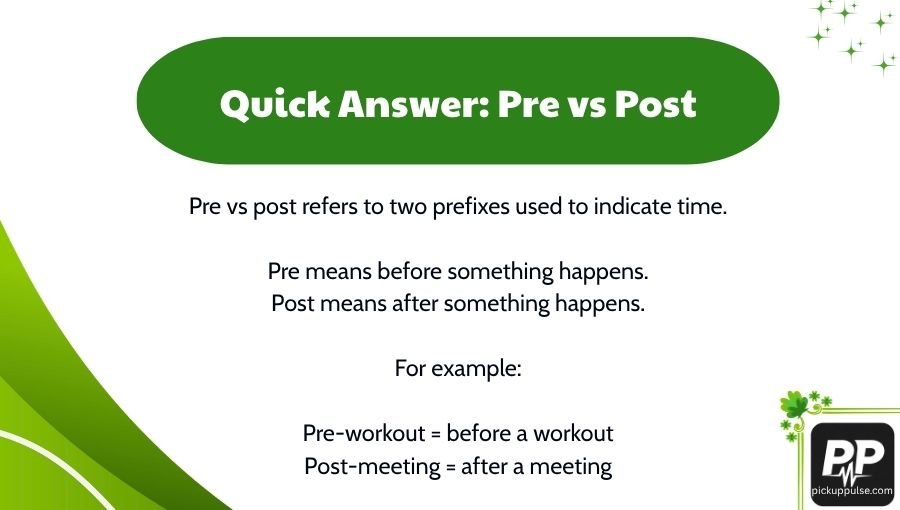
Pre vs post refers to two prefixes used to indicate time.
- Pre means before something happens.
- Post means after something happens.
For example:
- Pre-workout = before a workout
- Post-meeting = after a meeting
Understanding the Basics: Pre vs Post
At their core, pre and post are prefixes derived from Latin. They help describe timing relative to an event.
- Pre = Before
- Post = After
Comparison Table: Pre vs Post
| Feature | Pre | Post |
|---|---|---|
| Form | Prefix | Prefix |
| Type | Time indicator | Time indicator |
| Meaning | Before an event | After an event |
| Example | Pre-launch meeting | Post-launch review |
| Correct Usage | Pre-test preparation | Post-test analysis |
| Incorrect Usage | Post-before meeting ❌ | Pre-after meeting ❌ |
Correct Meanings & Uses
What Does “Pre” Mean?
Pre indicates something that happens before a specific event.
Examples:
- Pre-order the book before release.
- Breakdown: “Pre” + “order” = order before availability
- She did pre-interview research.
- Meaning: Research done before the interview
💡 Test Tip:
If the action happens earlier than the main event, use pre.
What Does “Post” Mean?
Post indicates something that happens after an event.
Examples:
- We had a post-meeting discussion.
- Meaning: Discussion after the meeting
- Post-surgery care is important.
- Meaning: Care after surgery
💡 Test Tip:
If the action happens later than the main event, use post.
Case Study Section 📊
Workplace Email Example
Scenario: A manager is organizing a product launch.
Email:
“Please complete the pre-launch checklist by Friday. We will schedule a post-launch review meeting next week.”
Analysis:
- Pre-launch checklist → Tasks before launch
- Post-launch review → Evaluation after launch
This example shows how pre vs post clearly separates phases of work, avoiding confusion.
Grammar Rules Explanation
According to standard grammar authorities like Merriam-Webster, both pre and post are prefixes that attach to root words.
Key Rules:
- Hyphen Usage
- Use a hyphen when clarity is needed:
- Pre-event ✔️
- Post-production ✔️
- Use a hyphen when clarity is needed:
- Closed Form (No Hyphen)
- Common words often drop the hyphen:
- Preview ✔️
- Postgraduate ✔️
- Common words often drop the hyphen:
- Avoid Redundancy
- Do not combine both meanings:
- ❌ Pre-before meeting
- ❌ Post-after event
- Do not combine both meanings:
Common Mistakes 🚫
Why Do Mistakes Happen?
- Fast typing ⌨️
- Autocorrect errors 📱
- Lack of grammar knowledge 📚
Common Confusion Table
| Incorrect Pair | Correct Form | Reason |
|---|---|---|
| Pre-after | Post | Mixed meanings |
| Post-before | Pre | Opposite logic |
| Its / It’s | Possession vs contraction | Grammar confusion |
| Your / You’re | Ownership vs “you are” | Common error |
| Then / Than | Time vs comparison | Misuse in sentences |
Usage in Different Contexts
Everyday Conversation 🗣️
- “Let’s do a pre-dinner walk.”
- “We’ll talk post-movie.”
Professional Writing 💼
- “Submit the pre-project report.”
- “Review the post-project outcomes.”
Creative Writing ✍️
- “The pre-storm silence felt eerie.”
- “Post-battle, the land was quiet.”
Social Media/Texting 📱
- “Pre-gym vibes 💪”
- “Post-vacation blues 😢”
Why It Matters ⭐
Using pre vs post correctly improves:
- Clarity in communication
- Professionalism
- Accuracy in writing
Even small errors can change meaning or confuse readers.
📌 “Clear language leads to clear thinking.”
Special Exception
Some words have become standard without hyphens:
- Preexisting (sometimes written as pre-existing)
- Postmodern
Always check a dictionary when unsure.
Quick Recap Checklist ✅
| Question | If Yes → Use |
|---|---|
| Does it happen before the event? | Pre |
| Does it happen after the event? | Post |
| Is timing clearly defined? | Choose accordingly |
Practice Examples:
- ___-workout meal → Pre
- ___-game analysis → Post
- ___production planning → Pre
FAQs Pre vs Post❓
What is the main difference between pre and post?
Pre means before an event, while post means after an event.
Should I always use a hyphen with pre and post?
No. Use a hyphen when needed for clarity, but many words are written without it.
Can pre and post be used in formal writing?
Yes, both are widely accepted in formal, academic, and professional writing.
Is “post” the opposite of “pre”?
Yes. They are direct opposites in terms of timing.
Are there exceptions to pre vs post rules?
Some words are standardized without hyphens, such as preview or postgraduate.
How can I remember the difference easily?
Think:
- Pre = Previous
- Post = After (like post-event recap)
Conclusion
Understanding pre vs post is simpler than it seems. These two prefixes are all about timing—pre refers to what happens before, and post refers to what happens after. Once you grasp this basic idea, using them correctly becomes second nature.
Whether you’re writing emails, essays, or social media posts, choosing the right prefix improves clarity and professionalism. Pay attention to hyphen usage, avoid redundancy, and always consider the timing of the action.
Mastering small grammar details like this can make a big difference in how your writing is perceived.
Remember:
👉 Pre comes before. Post comes after. Keep it simple, and you’ll get it right every time.
Also Read This: GNG Meaning in Text

Hi, I’m Zyler Knox, an expert in names and unique nickname creation. I specialize in developing fresh, modern, and expressive nicknames that add personality to every name.