To Fast or Too Fast: Understanding the Difference Clearly 🚦
“To Fast or Too Fast”—have you ever stopped mid-sentence and wondered which one is correct? You are not alone. This common grammar confusion affects students, professionals, and even fluent English speakers. At first glance, both phrases look almost identical, but their meanings are completely different.
The confusion usually comes from how similar “to” and “too” sound when spoken and how quickly we type without thinking. However, choosing the wrong form can make your sentence unclear or even grammatically incorrect.
Understanding the difference between “To Fast or Too Fast” is essential for clear communication. Whether you are writing emails, posting on social media, or working on professional documents, using the correct phrase helps you sound polished and accurate.
In this guide, you will learn when to use each form, how to avoid mistakes, and how to confidently apply this rule in real-life situations. Let’s make it simple and practical. ✨
Quick Answer: To Fast or Too Fast
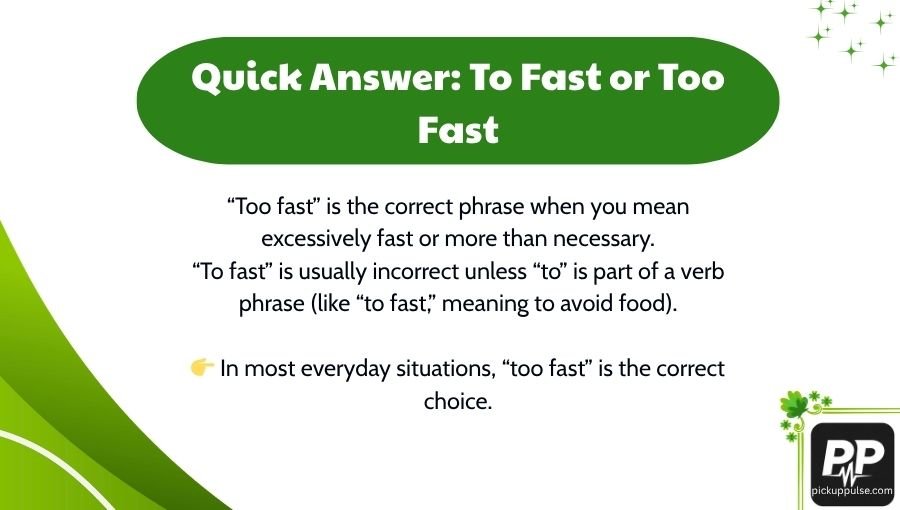
“Too fast” is the correct phrase when you mean excessively fast or more than necessary.
“To fast” is usually incorrect unless “to” is part of a verb phrase (like “to fast,” meaning to avoid food).
👉 In most everyday situations, “too fast” is the correct choice.
Understanding the Basics: To Fast vs Too Fast
Let’s simplify the difference.
- “Too” means more than enough or excessively.
- “To” is a preposition or part of an infinitive verb.
Comparison Table
| Form | Type | Meaning | Example | Correct/Incorrect |
|---|---|---|---|---|
| Too fast | Adverb phrase | Excessively fast | The car is moving too fast. | ✅ Correct |
| To fast | Preposition + verb | To abstain from food (rare use) | He decided to fast for a day. | ⚠️ Context-based |
| To fast | Incorrect usage | Mistaken form of “too fast” | She drives to fast. | ❌ Incorrect |
Correct Meanings & Uses
1. “Too Fast” – The Correct and Common Usage 🚀
“Too fast” is used when something happens faster than desired, safe, or expected.
Examples:
- The car was going too fast on the highway.
- You are speaking too fast for me to understand.
- The movie ended too fast.
Sentence Breakdown:
- “Too” modifies “fast” → It shows excess.
- It answers the question: How fast? → More than needed.
👉 Test Tip:
If you can replace “too” with “excessively,” then “too fast” is correct.
2. “To Fast” – Rare but Valid in Specific Contexts 🍽️
“To fast” is only correct when “fast” is used as a verb, meaning to abstain from food.
Examples:
- She plans to fast for religious reasons.
- He decided to fast before the medical test.
Sentence Breakdown:
- “To” + verb (“fast”) = infinitive form
- It describes an action
👉 Test Tip:
If “fast” means not eating, then “to fast” is correct.
Case Study Section: Real-Life Usage
Scenario: Workplace Email
❌ Incorrect:
“The system is running to fast and causing errors.”
✅ Correct:
“The system is running too fast and causing errors.”
Why This Matters:
- “To fast” makes no sense here.
- The writer meant excessively fast, so “too fast” is correct.
Scenario: Health Conversation
✅ Correct:
“I am planning to fast tomorrow.”
Why This Works:
- “Fast” is a verb.
- “To fast” correctly describes an action.
Grammar Rules Explanation 📘
According to standard grammar references like Merriam-Webster:
- “Too” is an adverb meaning also or excessively.
- “To” is a preposition or part of an infinitive verb.
Rule Summary:
- Use “too” when indicating excess.
- Use “to” only as part of a verb phrase or direction.
👉 This explains why “too fast” is almost always correct in speed-related contexts.
Common Mistakes ⚠️
Why Do People Confuse “To Fast” and “Too Fast”?
- Fast typing ⌨️
- Autocorrect errors 🤖
- Similar pronunciation 🔊
- Lack of grammar awareness 📚
Common Grammar Confusions Table
| Confusion | Correct Example | Explanation |
|---|---|---|
| Its / It’s | It’s raining. | “It’s” = it is |
| Your / You’re | You’re amazing. | “You’re” = you are |
| Then / Than | Bigger than before | “Than” = comparison |
| To / Too | Too fast | “Too” = excessive |
| There / Their | Their house | Possession |
Usage in Different Contexts
1. Everyday Conversation 🗣️
- “You’re walking too fast!”
- “Slow down—you’re driving too fast.”
2. Professional Writing 💼
- “The project timeline is moving too fast for proper review.”
- “The system processes data too fast, leading to errors.”
3. Creative Writing ✍️
- “Time slipped away too fast, like sand through fingers.”
- “His heart beat too fast in the silent night.”
4. Social Media & Texting 📱
- “Life goes too fast 😢”
- “Why is this week going too fast?!”
Why It Matters 🎯
Using the correct phrase is not just about grammar—it impacts:
- Clarity: Prevents confusion
- Professionalism: Shows attention to detail
- Accuracy: Enhances credibility
✨ “Clear language builds clear thinking.”
Even small grammar choices can shape how others perceive your writing.
Special Exception
There are very few exceptions where “to fast” is used. It mainly appears in:
- Religious contexts
- Medical instructions
- Dietary practices
Example:
- “Patients are required to fast before surgery.”
Outside of these contexts, “too fast” is almost always correct.
Quick Recap Checklist ✅
| Question | If Yes → Use |
|---|---|
| Does it mean excessively fast? | Too fast |
| Can you replace it with “very fast”? | Too fast |
| Is “fast” used as a verb (not eating)? | To fast |
Practice Examples:
- She was ಮಾತನಾಡing ___ fast. → too fast
- He decided ___ before the test. → to fast
- The car is going ___ fast. → too fast
FAQs Section ❓
Is “to fast” ever correct?
Yes, but only when “fast” is used as a verb meaning to avoid food. Example: “She wants to fast.”
Why is “too fast” more common?
Because it describes speed or excess, which appears frequently in everyday communication.
Can “too fast” be used in formal writing?
Absolutely. It is grammatically correct and widely accepted in both formal and informal contexts.
How can I quickly check which one to use?
Replace “too” with “excessively.” If the sentence still makes sense, use “too fast.”
Is “to fast” a grammar mistake?
It is a mistake when used instead of “too fast,” but correct in specific contexts involving fasting.
Why does autocorrect not always fix this?
Because both “to” and “too” are valid words, autocorrect cannot always detect context.
Conclusion
Understanding the difference between “to fast” and “too fast” is simpler than it first appears. In most situations, “too fast” is the correct choice, as it clearly expresses excess speed. On the other hand, “to fast” is only appropriate when referring to the act of not eating.
By remembering this key distinction and using quick test tips like replacing “too” with “excessively,” you can avoid common mistakes and write with confidence. Whether in casual conversations or professional documents, using the correct form ensures clarity and precision.
Mastering small grammar details like this makes a big difference over time.
Write clearly, think sharply, and never let confusion slow you down—even when things move too fast. 🚀
Also Read This: Hastle vs Hassle

Hi, I’m Daxter Wilde, an expert in names who enjoys designing creative and distinctive nicknames. My goal is to turn simple names into something fun, memorable, and full of character.