Cartel vs Mafia: Key Differences, Real-World Examples, and Everything You Need to Know
When people search for cartel vs mafia, they are usually trying to understand what really separates these two powerful criminal systems that dominate headlines, movies, and global news. The terms are often used interchangeably, which creates confusion about how these organizations actually work in real life. Are they the same thing, or do they operate in completely different ways? 🎭
The truth is that the confusion around cartel vs mafia comes from how both are involved in organized crime, secrecy, and illegal economies. However, one is more like a decentralized business-style alliance focused on controlling markets, while the other functions like a strict, hierarchical criminal family with centralized authority. Understanding this distinction is not just about definitions—it helps make sense of international crime reports, law enforcement strategies, and geopolitical discussions.
In this article, we will break down everything you need to know about cartel vs mafia, including their origins, structures, operations, real-world examples, and key differences. By the end, you’ll have a clear, accurate understanding of how these two systems are similar—and how they are fundamentally different.
Quick Answer: Cartel vs Mafia
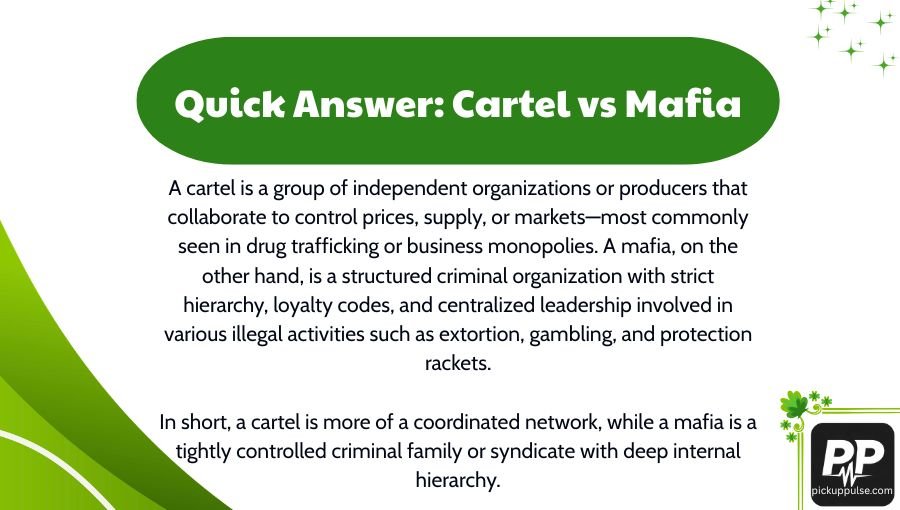
A cartel is a group of independent organizations or producers that collaborate to control prices, supply, or markets—most commonly seen in drug trafficking or business monopolies. A mafia, on the other hand, is a structured criminal organization with strict hierarchy, loyalty codes, and centralized leadership involved in various illegal activities such as extortion, gambling, and protection rackets.
In short, a cartel is more of a coordinated network, while a mafia is a tightly controlled criminal family or syndicate with deep internal hierarchy.
Understanding the Basics: Cartel vs Mafia
To fully understand cartel vs mafia, we need to break down their core characteristics side by side.
Comparison Table: Cartel vs Mafia
| Feature | Cartel | Mafia |
|---|---|---|
| Form | Network/Alliance | Hierarchical Organization |
| Type | Cooperative criminal/business group | Structured criminal syndicate |
| Meaning | Group controlling supply or pricing of illegal/legal goods | Organized crime family with strict hierarchy |
| Example | Drug cartels in Latin America | Italian Mafia (Cosa Nostra) |
| Structure | Loosely connected members | Strict chain of command |
| Correct/Incorrect Confusion | Often mistaken as mafia-type gang | Often mistaken as cartel |
What Is a Cartel?
A cartel is a group of independent organizations that come together to control a specific market, reduce competition, or maximize profits. While cartels can exist legally in business theory (like oil or trade agreements), the term is most commonly used to describe drug cartels.
Key Characteristics of Cartels
- Operate as alliances, not single unified organizations
- Focus on controlling supply chains and prices
- Members may still operate independently
- Often seen in drug trafficking, oil markets, and illegal trade
- Use cooperation rather than strict hierarchy
Example of a Cartel
A well-known example is the Sinaloa Cartel in Mexico, which coordinates drug production and distribution routes across multiple regions while allowing different groups to operate semi-independently.
👉 Example sentence:
“The cartel controls the supply of narcotics across several borders through coordinated distribution networks.”
What Is a Mafia?
A mafia is a highly organized criminal group with a strict hierarchy, loyalty system, and internal code of conduct. Unlike cartels, mafias operate like criminal families.
Key Characteristics of Mafia Organizations
- Strong central leadership (boss structure)
- Members follow strict loyalty and silence codes (Omertà in Italian Mafia)
- Engage in multiple illegal activities: extortion, gambling, smuggling
- Operate like a corporate hierarchy
- Focus on territorial control and influence
Example of a Mafia Group
The Sicilian Mafia (Cosa Nostra) is one of the most famous examples. It operates with a boss, underboss, and soldiers who follow strict rules.
👉 Example sentence:
“The mafia enforced its control over the city through intimidation and protection rackets.”
Cartel vs Mafia: Key Differences Explained
While both are criminal in nature, their structure and strategy are very different.
1. Structure Difference
- Cartel: Decentralized, cooperative network
- Mafia: Centralized, hierarchical organization
2. Purpose Difference
- Cartel: Control supply, prices, or markets
- Mafia: Maintain power, territory, and influence
3. Operational Style
- Cartel: Collaboration among groups
- Mafia: Strict command and obedience
4. Flexibility
- Cartel: Members can act independently
- Mafia: Members must follow orders from leadership
Correct Meanings & Uses
Cartel in Real Context
Cartels are often associated with drug trafficking networks, especially in Latin America. They coordinate production, transportation, and distribution.
Example:
“The cartel negotiated routes to ensure uninterrupted supply across borders.”
Mafia in Real Context
Mafia groups operate like underground governments, influencing politics, businesses, and communities.
Example:
“The mafia controlled local businesses through fear and intimidation.”
Test Tip 🧠
If the group acts like a network of independent partners → Cartel
If the group acts like a family with strict leadership → Mafia
Case Study: Real-Life Scenario
Imagine a news report:
A government investigation reveals illegal drug movement across three countries.
- Group A consists of multiple independent drug producers cooperating to control pricing and distribution → Cartel
- Group B is a single family-run organization controlling gambling, protection rackets, and political bribery in a city → Mafia
This shows how both can exist in the same ecosystem but function very differently.
Grammar Rules Explanation (Terminology Clarity)
According to standard definitions (such as those found in Merriam-Webster Dictionary):
- Cartel refers to an association of producers or organizations that regulate prices or supply.
- Mafia refers to a secret criminal organization with structured hierarchy and influence.
The confusion happens not because of grammar errors, but because both terms are used interchangeably in media. However, linguistically and contextually, they represent distinct organizational models.
So, using them incorrectly is not a grammar mistake—but a conceptual misunderstanding.
Common Mistakes in Understanding Cartel vs Mafia
People often confuse these terms due to media portrayal and oversimplification.
Why Confusion Happens
- Fast consumption of news headlines
- Movies blending criminal organizations
- Lack of context in reporting
- Assumption that all gangs are the same
Common Confusion Table
| Confusion Pair | Correct Understanding | Why Mistake Happens |
|---|---|---|
| Cartel = Mafia | False | Both are criminal in media |
| Mafia = Cartel | False | Overlapping illegal activities |
| Gang = Cartel/Mafia | Sometimes false | Scale and structure differ |
Usage in Different Contexts
Everyday Conversation 🗣️
- “That movie showed a cartel operation in Mexico.”
- “The mafia storyline was intense in the series.”
Professional Writing 📊
- “The cartel’s pricing strategy disrupted global markets.”
- “The mafia’s influence extended into political systems.”
Creative Writing ✍️
- Cartels often appear as global networks of power
- Mafias appear as family-driven criminal empires
Social Media 💬
- “That show gave serious cartel energy 😳”
- “Mafia-level control in that storyline!”
Why Understanding Cartel vs Mafia Matters
Understanding the difference improves how we interpret global issues.
Key Reasons
- Improves news comprehension
- Helps in academic and research accuracy
- Enhances critical thinking about crime and politics
- Avoids misinformation in media discussions
“Clarity in terms leads to clarity in thought.”
Special Exception
In some media and casual usage, the terms cartel and mafia are used loosely to describe any powerful criminal organization. However, in legal, academic, and law enforcement contexts, they maintain distinct definitions.
Quick Recap Checklist
| Question | If Yes → Use |
|---|---|
| Is it a network of independent groups? | Cartel |
| Is it a strict family-like hierarchy? | Mafia |
| Is the goal price/supply control? | Cartel |
| Is the goal territorial influence and control? | Mafia |
Practice Examples
- A group of suppliers controlling drug routes together → Cartel
- A crime family running extortion rings in a city → Mafia
- Multiple independent producers agreeing on pricing → Cartel
FAQs: Cartel vs Mafia
What is the main difference between cartel and mafia?
A cartel is a cooperative network controlling markets, while a mafia is a hierarchical criminal organization with strict leadership.
Are cartels and mafias the same thing?
No. They are both criminal in many cases, but their structure and operations are fundamentally different.
Which is more organized: cartel or mafia?
Mafias are generally more structured and hierarchical, while cartels are more decentralized.
Do cartels only deal with drugs?
No. While drug cartels are common, cartels can also exist in business sectors like oil or trade.
Is mafia only Italian?
No. Mafias exist worldwide, including Russian, Japanese (Yakuza), and American organized crime groups.
Why do people confuse cartel and mafia?
Because movies and media often portray them similarly as powerful criminal organizations.
Conclusion
Understanding cartel vs mafia is essential for making sense of how organized crime is portrayed and discussed around the world. While both terms describe powerful illegal groups, they operate in very different ways. A cartel functions as a cooperative network focused on controlling supply and markets, while a mafia is a structured, hierarchical organization built around loyalty, control, and influence.
Recognizing these differences helps improve how we interpret news, media, and global events. It also highlights the importance of precise language when discussing complex social systems.
In the end, the distinction is simple but powerful: cartels coordinate, mafias command.
Also Read This: Input vs Imput

Hi, I’m Tavian Cross, an expert in names and the art of creating meaningful, stylish, and memorable nicknames. I focus on crafting original name ideas that feel personal, creative, and easy to connect with.