Hastle vs Hassle: The Complete Guide to Meaning, Difference, and Correct Usage (2026)
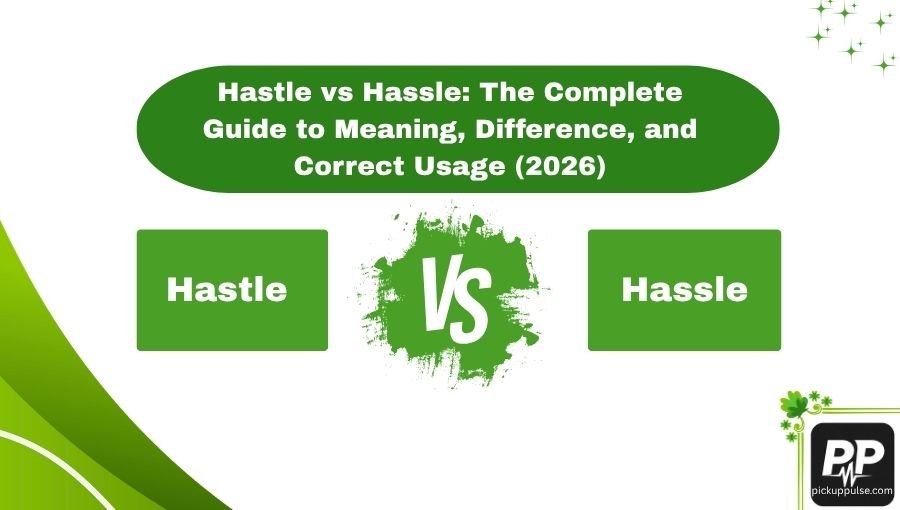
The confusion between hastle vs hassle is more common than most people realize, especially when typing quickly in emails, chats, or social media posts. Many writers accidentally use “hastle,” assuming it is a correct spelling, when in fact the proper English word is “hassle.” This small mistake can change how polished or professional your writing appears, even though the meaning you intend is usually clear.
The issue becomes even more interesting because both versions look and sound similar, making it easy to overlook the error. English spelling is full of traps like this, where one extra or missing letter completely changes correctness. Understanding the difference between hastle vs hassle helps you avoid these small but noticeable mistakes in everyday communication.
In this guide, we’ll break everything down in a simple way—what “hassle” really means, why “hastle” is incorrect, and how to confidently use the right form in any situation 😊.
Quick Answer: Hastle vs Hassle
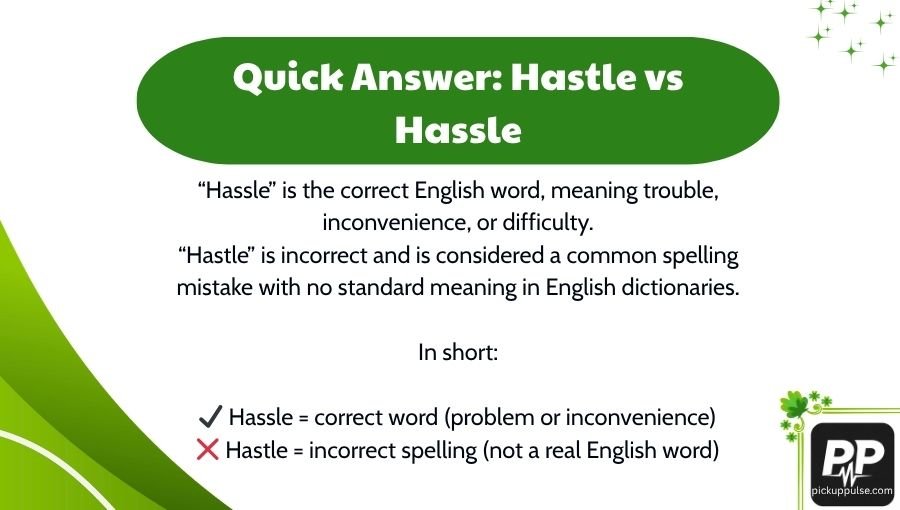
“Hassle” is the correct English word, meaning trouble, inconvenience, or difficulty.
“Hastle” is incorrect and is considered a common spelling mistake with no standard meaning in English dictionaries.
In short:
- ✔️ Hassle = correct word (problem or inconvenience)
- ❌ Hastle = incorrect spelling (not a real English word)
Understanding the Basics: Hastle vs Hassle
To fully understand the confusion between hastle vs hassle, it helps to break down what each form represents.
What does “hassle” mean?
“Hassle” is a noun and verb used in English to describe something annoying, troublesome, or inconvenient.
Example meanings:
- A problem or difficulty
- A stressful situation
- To annoy or bother someone
Example sentences:
- “Moving to a new apartment is always a hassle.”
- “Don’t hassle me while I’m working.”
What about “hastle”?
“Hastle” does not exist as a standard English word. It is simply:
- A spelling error
- A typo caused by fast typing
- A mishearing or misremembering of “hassle”
Comparison Table: Hastle vs Hassle
| Form | Type | Meaning | Example Sentence | Correct/Incorrect |
|---|---|---|---|---|
| Hassle | Word (noun/verb) | Trouble, inconvenience, annoy | “This process is a hassle.” | ✔️ Correct |
| Hastle | Misspelling | No meaning in standard English | “This is a hastle.” (incorrect) | ❌ Incorrect |
Correct Meaning and Uses of “Hassle”
Let’s go deeper into how “hassle” works in real English communication.
1. “Hassle” as a Noun
As a noun, “hassle” refers to something that causes stress or inconvenience.
Examples:
- “Airport security can be a hassle.”
- “Dealing with paperwork is such a hassle.”
🔍 Sentence breakdown:
- Subject: Airport security
- Verb (implied): is
- Complement: a hassle (problem/difficulty)
💡 Test Tip:
If you can replace it with “problem” or “inconvenience,” then “hassle” is correct.
2. “Hassle” as a Verb
As a verb, it means to annoy, pressure, or bother someone repeatedly.
Examples:
- “Stop hassling me about homework.”
- “They kept hassling him for updates.”
🔍 Sentence breakdown:
- Subject: They
- Verb: kept hassling
- Object: him
💡 Test Tip:
If the action involves “bothering someone,” the verb form “hassle” is correct.
Why “Hastle” is Incorrect
The word “hastle” is often mistaken for a real word because:
- It visually resembles “hustle”
- It sounds similar when spoken quickly
- Autocorrect sometimes fails to catch it
- People assume it’s an alternative spelling
However, according to standard dictionaries like Merriam-Webster and Oxford English Dictionary, “hastle” has no entry as a recognized word in modern English.
Case Study: Real-Life Usage Example
Let’s look at how this confusion appears in everyday communication.
Scenario: Workplace Email
❌ Incorrect version:
“Sorry for the hastle, I will send the report soon.”
✔️ Correct version:
“Sorry for the hassle, I will send the report soon.”
What happened here?
The writer intended to apologize for inconvenience but used the incorrect spelling “hastle.” In a professional environment, this can:
- Reduce credibility
- Look careless
- Affect communication clarity
Improved professional version:
“Apologies for the hassle caused. I will send the updated report shortly.”
Grammar Rules Explanation
So why is “hassle” correct and “hastle” wrong?
Standard English Rule:
English spelling is standardized through dictionaries and linguistic usage. A word is only valid if it:
- Appears in recognized dictionaries
- Has consistent usage in literature and speech
- Has accepted meaning and grammar function
“Hassle” meets all these conditions.
“Hastle” fails all of them.
Dictionary Authority Reference:
-
Merriam-Webster defines “hassle” as:
“a troublesome situation or inconvenience”
- No entry exists for “hastle” in standard English dictionaries.
Key Grammar Insight:
English does not accept alternative spellings unless they are officially recognized (like “color” vs “colour”). “Hastle” is not one of those exceptions.
Common Mistakes and Similar Confusions
The “hastle vs hassle” issue is part of a larger group of common English spelling errors.
Why do these mistakes happen?
- ⚡ Fast typing without proofreading
- 📱 Autocorrect mistakes or suggestions
- 🧠 Memory confusion from similar sounding words
- 📚 Lack of exposure to correct spelling
Similar Grammar Confusion Table
| Incorrect | Correct | Reason for Confusion |
|---|---|---|
| Your | You’re | Sound alike in speech |
| Its | It’s | Apostrophe confusion |
| Then | Than | Similar pronunciation |
| Definately | Definitely | Fast typing error |
| Hastle | Hassle | Misspelling due to sound similarity |
Usage in Different Contexts
1. Everyday Conversation 🗣️
- “That commute is such a hassle.”
2. Professional Writing 💼
- “We aim to reduce administrative hassle for clients.”
3. Creative Writing ✍️
- “Life’s little hassles often shape our patience.”
4. Social Media & Texting 📱
- “No hassle, I got it covered!”
Why It Matters: Clarity in Communication
Using correct spelling like “hassle” instead of “hastle” is more than just grammar—it impacts how others perceive your communication.
Why accuracy matters:
- Improves professionalism
- Builds credibility
- Enhances clarity
- Reduces misunderstandings
“Good writing is clear thinking made visible.”
Even small spelling errors can affect how seriously your message is taken.
Special Exception
There are no recognized linguistic exceptions where “hastle” is considered correct in standard English.
However:
- “Hastle” may appear as a surname, brand name, or fictional term in rare cases.
- These uses are proper nouns, not grammar rules.
So in normal writing, always default to “hassle.”
Quick Recap Checklist
| Question | If Yes → Use |
|---|---|
| Are you referring to trouble or inconvenience? | Use “hassle” |
| Are you describing annoyance or difficulty? | Use “hassle” |
| Did you type “hastle”? | Replace with “hassle” |
Practice Examples
- ❌ “This process is a hastle.”
✔️ “This process is a hassle.” - ❌ “Don’t hastle me.”
✔️ “Don’t hassle me.” - ❌ “Traveling without stress is possible if you avoid hastle.”
✔️ “Traveling without stress is possible if you avoid hassle.”
FAQs: Hastle vs Hassle
Is “hastle” a real word?
No, “hastle” is not a recognized English word. It is simply a spelling mistake of “hassle.”
What does “hassle” mean?
“Hassle” means inconvenience, trouble, or something annoying that causes difficulty.
Why do people write “hastle” instead of “hassle”?
It usually happens due to fast typing, autocorrect errors, or confusion with similar-sounding words.
Is “hassle” formal or informal?
“Hassle” can be used in both formal and informal English depending on context.
Can “hassle” be used as a verb?
Yes. It can mean to bother or annoy someone repeatedly.
How can I remember the correct spelling?
Think: “It’s a hassle to spell it wrong—so always use double ‘s’!”
Conclusion
The confusion between “hastle vs hassle” is a simple but common English mistake that can easily slip into everyday writing. The key takeaway is clear: “hassle” is the only correct spelling, while “hastle” is an incorrect form with no standard meaning in English.
Understanding this difference helps improve your writing accuracy, especially in professional and academic communication. It also strengthens your overall language confidence by reducing avoidable spelling errors.
Next time you’re writing about inconvenience, trouble, or frustration, remember this simple rule: one “a,” two “s’s”—and no confusion 😊. Clear spelling leads to clear communication, and clear communication always makes a stronger impression.
Also Read This: Artefact or Artifact

Hi, I’m Rylan Dorsey, a creative wordsmith who loves crafting pick-up lines, puns, and nicknames. At PickupPulse.com, I share fun, original content designed to entertain and bring a smile.