Artefact or Artifact: Meaning, Difference, Usage, and Complete Guide
Have you ever stopped mid-writing and wondered whether to use artefact or artifact? 🤔 This tiny spelling difference creates a lot of confusion because both versions appear in books, museums, academic papers, and even online articles. The truth is that artefact or artifact refers to the same concept, but the spelling depends on whether you are using British or American English.
In American English, “artifact” is the standard spelling, while in British English, “artefact” is preferred. This variation often leads to uncertainty, especially for students, writers, and professionals who publish content for a global audience. Choosing the wrong version won’t change the meaning, but it can affect consistency and professionalism in writing.
In this article, we will clearly break down artefact or artifact, explain their meanings, usage rules, grammar differences, and common mistakes. You will also see real-world examples, comparison tables, and practical writing tips so you can confidently choose the correct form every time. ✍️
Quick Answer: Artefact or Artifact Meaning
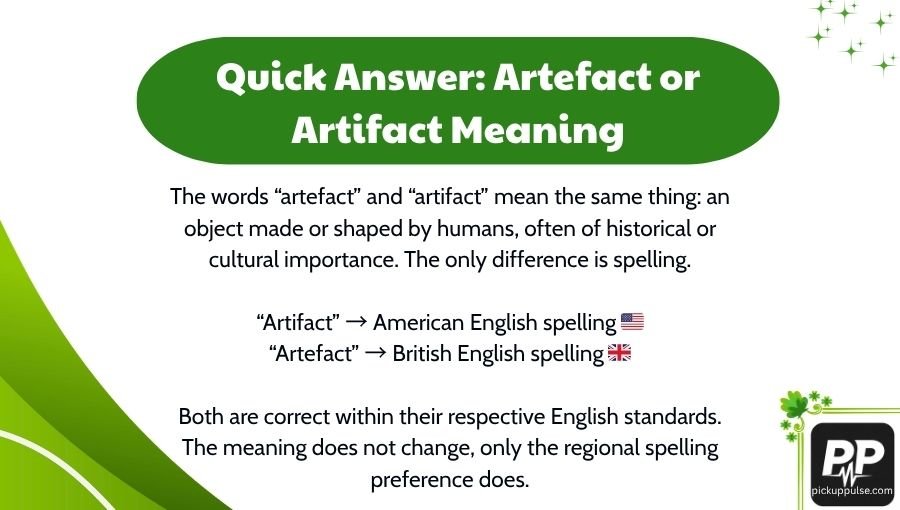
The words “artefact” and “artifact” mean the same thing: an object made or shaped by humans, often of historical or cultural importance. The only difference is spelling.
- “Artifact” → American English spelling 🇺🇸
- “Artefact” → British English spelling 🇬🇧
Both are correct within their respective English standards. The meaning does not change, only the regional spelling preference does.
Understanding the Basics: Artefact vs Artifact
To fully understand artefact or artifact, we need to look at how English varies across regions. English is not a single uniform language—it adapts depending on geography, education systems, and publishing standards.
Core Meaning
An artifact/artefact refers to:
- An object made by humans (not naturally occurring)
- Items from historical or archaeological significance
- Tools, pottery, weapons, or cultural objects
- Sometimes digital objects in computing (like system artifacts)
Simple Breakdown
- If you are writing for the US audience, use artifact
- If you are writing for the UK, Australia, or most Commonwealth countries, use artefact
- If your audience is global, choose one style and stay consistent
Comparison Table: Artefact vs Artifact
| Form | Type of English | Meaning | Example | Correct/Incorrect |
|---|---|---|---|---|
| Artifact | American English | Human-made historical object | The museum displayed an ancient artifact. | Correct (US) |
| Artefact | British English | Human-made historical object | The museum displayed an ancient artefact. | Correct (UK) |
| Artifacte ❌ | Incorrect spelling | None | N/A | Incorrect |
| Artefakt ❌ | Non-English variant | None | N/A | Incorrect |
Correct Meanings & Uses of Artifact / Artefact
1. Historical Meaning 🏺
In archaeology, an artifact/artefact is any object created by humans in the past.
Example:
- The archaeologists discovered an artifact buried under the desert sand.
Breakdown:
- “archaeologists” = subject
- “discovered” = action
- “artifact” = object (noun)
2. Cultural Meaning 🎭
Artifacts represent cultural identity, traditions, and human behavior.
Example:
- The museum preserves cultural artifacts from ancient civilizations.
3. Scientific / Technical Meaning 💻
In computing, an artifact can refer to generated output like logs, files, or system data.
Example:
- The software build produced several deployment artifacts.
Test Tip 🧠
If the word refers to something created by humans and preserved or observed, it is likely an artifact/artefact.
Case Study: Real-Life Usage Scenario
Imagine an email exchange in a museum research team:
Email Example:
Subject: Artifact Documentation Update
Dear Team,
During our recent excavation, we recovered a ceramic artifact believed to be from the 3rd century BCE. The artifact shows signs of ritual use and will be sent for carbon dating.
Best regards,
Dr. Emily Carter
Why this works:
- Uses American spelling (“artifact”) consistently
- Maintains formal tone
- Applies correct archaeological context
If this email were written in the UK:
- “artefact” would replace “artifact” throughout
Grammar Rules Explanation
According to Merriam-Webster and Oxford English Dictionary, both spellings are correct but region-specific.
Rule Summary:
- Artifact = American English standard
- Artefact = British English standard
Why both exist
The difference comes from historical spelling reforms:
- American English simplified many spellings (colour → color, artefact → artifact)
- British English preserved Latin-based forms more closely
Why “artifact” is more common online 🌐
- Most global tech companies use US English
- SEO and digital content often default to American spelling
- Software documentation prefers consistency
Common Mistakes
Many writers confuse or mix both forms unintentionally.
Why mistakes happen:
- Fast typing ⌨️
- Autocorrect interference 📱
- Lack of awareness of regional spelling differences
- Mixing UK and US English in one document
Common Confusion Table
| Confusing Pair | Correct Usage | Incorrect Usage | Reason |
|---|---|---|---|
| artifact/artefact | Depends on region | mixing both randomly | Inconsistency |
| color/colour | color (US), colour (UK) | colur ❌ | spelling error |
| organize/organise | depends on region | organice ❌ | incorrect form |
| traveled/travelled | US/UK variation | traveld ❌ | missing letter |
Usage in Different Contexts
1. Everyday Conversation 🗣️
- “I saw an ancient artifact in the museum today.”
2. Professional Writing 📄
- Research papers, reports, and academic writing must follow a consistent style guide.
3. Creative Writing ✍️
- Writers may choose either spelling but must remain consistent throughout the story.
4. Social Media & Texting 📱
- “This old coin looks like a rare artifact!”
Why It Matters (Important )
Choosing between artefact or artifact may seem small, but it significantly impacts clarity and professionalism.
Key reasons:
- Improves readability 📖
- Maintains credibility in academic or professional writing
- Prevents confusion in international communication
- Enhances SEO consistency for digital content
“Precision in language is not just grammar—it is respect for your reader.”
Special Exception
In some cases, institutions or brands may enforce a specific spelling:
- British museums → “artefact”
- American universities → “artifact”
- International organizations → choose based on style guide (APA, MLA, Chicago)
No other major exceptions exist.
Quick Recap Checklist
| Question | If Yes → Use |
|---|---|
| Writing for US audience? | artifact |
| Writing for UK audience? | artefact |
| Mixed/global audience? | Choose one and stay consistent |
| Academic paper (APA US)? | artifact |
| British academic writing? | artefact |
Practice Examples:
- The archaeologist found an ______ in the tomb.
- The museum displayed a rare ______ from Rome.
- Digital systems generate software ______ during build processes.
(Answers: artifact / artefact depending on region consistency)
FAQs: Artefact or Artifact
What is the difference between artefact and artifact?
There is no difference in meaning. The only difference is spelling based on British (artefact) and American (artifact) English.
Which spelling is correct in the US?
In the United States, artifact is the correct and standard spelling.
Which spelling is used in the UK?
In the UK and most Commonwealth countries, artefact is commonly used.
Can I mix both spellings in one article?
No. Mixing both creates inconsistency and looks unprofessional. Always choose one style.
Is artifact only used in archaeology?
No. It is also used in computing, science, and cultural studies.
Which spelling is better for SEO?
“Artifact” generally performs better globally due to American English dominance in digital content, but consistency matters more than choice.
Conclusion
The debate between artefact or artifact is not about correctness but about regional language variation. Both words mean the same thing—an object created by humans, often carrying historical, cultural, or technical significance. The only difference lies in whether you are using British English (artefact) or American English (artifact).
For writers, students, and professionals, the key takeaway is consistency. Once you choose a style, stick with it throughout your writing. This improves clarity, strengthens credibility, and enhances readability across audiences.
In a global digital world, small spelling choices like this matter more than ever. Mastering them helps you communicate with precision and confidence. ✨
Also Read This: Invision or Envision

Hi, I’m Tavian Cross, an expert in names and the art of creating meaningful, stylish, and memorable nicknames. I focus on crafting original name ideas that feel personal, creative, and easy to connect with.