Tear vs Tare: What’s the Difference? 🤔📚
Have you ever paused mid-sentence, unsure whether to write tear or tare? You are not alone. These two words sound similar, but they carry entirely different meanings—and using the wrong one can change your message completely. Whether you are writing an email, a report, or even a social media post, understanding the difference between tear vs tare is essential for clear communication.
This confusion often happens because English is full of homophones and near-homophones—words that sound alike but have different meanings and spellings. Add in fast typing, autocorrect, and everyday habits, and it is easy to mix them up.
In this guide, you will learn everything you need to know about tear vs tare, including meanings, correct usage, grammar rules, and practical examples. By the end, you will confidently choose the right word every time—no second-guessing needed. ✍️
Quick Answer: Tear vs Tare
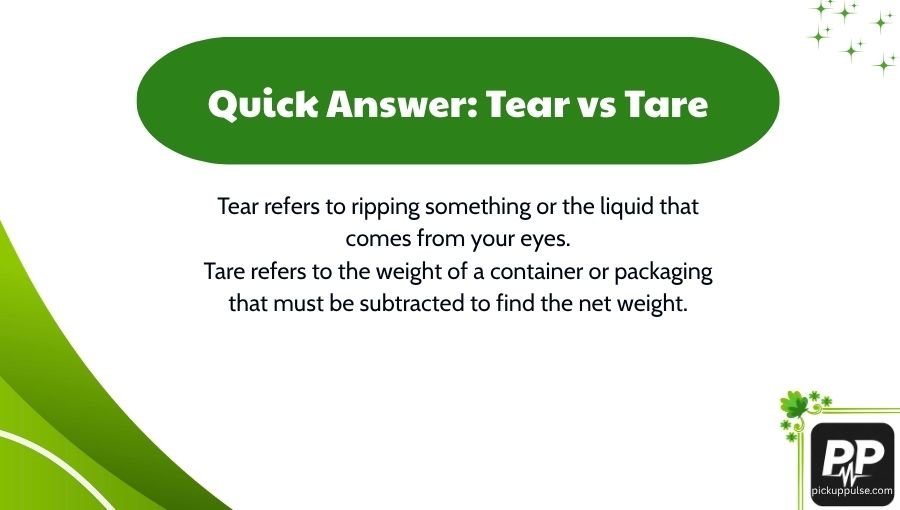
Tear refers to ripping something or the liquid that comes from your eyes.
Tare refers to the weight of a container or packaging that must be subtracted to find the net weight.
Understanding the Basics: Tear vs Tare
The difference between tear vs tare is simple once you understand their roles:
- Tear → Emotional or physical action (rip or cry)
- Tare → Measurement term used in weighing systems
Comparison Table
| Form | Type | Meaning | Example Sentence | Correct/Incorrect |
|---|---|---|---|---|
| Tear | Noun/Verb | Rip or drop from the eye | She had a tear in her shirt. | ✅ Correct |
| Tear | Noun | Liquid from eyes | A tear rolled down his cheek. | ✅ Correct |
| Tare | Noun/Verb | Weight of container | Subtract the tare to get net weight. | ✅ Correct |
| Tare | Verb | To reset scale weight | Please tare the scale before measuring. | ✅ Correct |
| Tear | Used for weight | Incorrect usage | The tare weight is 5 kg. | ❌ Incorrect |
Correct Meanings & Uses
1. What Does “Tear” Mean? 😢
Tear has two main meanings:
A. Tear (Noun) – Liquid from the Eye
- Example: A tear rolled down her face.
- Breakdown:
- Subject: A tear
- Verb: rolled
- Meaning: Emotional expression
B. Tear (Verb) – To Rip Something
- Example: Do not tear the paper.
- Breakdown:
- Verb: tear
- Object: paper
- Meaning: Physical damage
💡 Test Tip:
If the sentence involves emotions or ripping, use tear.
2. What Does “Tare” Mean? ⚖️
Tare is mainly used in weighing and measurement.
A. Tare (Noun)
- Meaning: The weight of packaging or container
- Example: The tare weight of the box is 2 pounds.
B. Tare (Verb)
- Meaning: To reset a scale to zero
- Example: Tare the scale before adding ingredients.
💡 Test Tip:
If the sentence relates to weight, scales, or measurement, use tare.
Case Study Section 📧
Workplace Email Example
Incorrect Usage:
Please tear the scale before measuring the items.
Correct Usage:
Please tare the scale before measuring the items.
Why It Matters:
Using tear here creates confusion. It suggests damaging the scale rather than resetting it.
Grammar Rules Explanation 📖
According to Merriam-Webster Dictionary:
- Tear:
- Noun: “A drop of fluid from the eye”
- Verb: “To pull apart or rip”
- Tare:
- Noun: “The weight of a container”
- Verb: “To set a scale to zero”
Key Rule:
- Use tear for emotional or physical actions
- Use tare for technical measurement contexts
Common Mistakes Section 🚫
Why Do People Confuse Tear vs Tare?
- Fast typing ⌨️
- Autocorrect errors 📱
- Similar pronunciation 🔊
- Lack of awareness 📉
Similar Grammar Confusions Table
| Confusion Pair | Meaning Difference |
|---|---|
| It’s / Its | It is vs possession |
| Your / You’re | Possession vs you are |
| There / Their / They’re | Place vs possession vs they are |
| Affect / Effect | Verb vs noun |
| Tear / Tare | Rip/cry vs weight measurement |
Usage in Different Contexts
Everyday Conversation 🗣️
- “I got a tear in my jeans.”
- “A tear fell from her eye.”
Professional Writing 💼
- “Ensure you tare the scale before weighing items.”
Creative Writing ✍️
- “A single tear traced her cheek under the moonlight.”
Social Media/Texting 📱
- “That movie made me tear up 😢”
- “Don’t forget to tare the scale!”
Why It Matters 🎯
Understanding tear vs tare is more than just grammar—it is about clarity and credibility.
- Clear communication avoids confusion
- Correct usage builds professionalism
- Accuracy improves digital writing quality
💬 “Words are the tools of thought—use the right one, and your message becomes powerful.”
Special Exception ⚠️
There are no major exceptions, but note:
- “Tear” pronunciation varies:
- Teer (rip)
- Tair (liquid from eye)
- “Tare” is mostly used in technical fields like logistics, cooking, and manufacturing.
Quick Recap Checklist ✅
| Question | If Yes → Use |
|---|---|
| Is it about crying or emotion? | Tear |
| Is it about ripping something? | Tear |
| Is it about weight or measurement? | Tare |
| Is it about resetting a scale? | Tare |
Practice Examples
- Please ___ the scale before weighing. → Tare
- She wiped away a ___ from her eye. → Tear
- Be careful not to ___ the paper. → Tear
FAQs Tear vs Tare❓
What is the main difference between tear and tare?
Tear relates to ripping or crying, while tare refers to weight measurement and scale adjustment.
Can tear and tare be used interchangeably?
No, they have completely different meanings and are not interchangeable.
How do I remember when to use tare?
Think of tare as related to weight and scales—both are technical terms.
Is tare commonly used in everyday language?
Not often. It is mainly used in cooking, shipping, and industrial settings.
Why does tear have two pronunciations?
Because it has different meanings—one for ripping (teer) and one for crying (tair).
What happens if I use tear instead of tare in professional writing?
It can cause confusion and make your writing seem less accurate or professional.
Conclusion
Understanding the difference between tear vs tare is simple once you break it down. Tear deals with emotion and physical action—either crying or ripping—while tare belongs to the world of measurement and precision. Mixing them up might seem minor, but it can lead to confusion, especially in professional or technical contexts.
By remembering their core meanings and practicing their usage, you can avoid common mistakes and communicate more clearly. Whether you are writing casually or professionally, choosing the right word shows attention to detail and strengthens your message.
Mastering small distinctions like this makes a big difference. In the end, the right word is not just correct—it is powerful. 💡
Also Read This: Propose vs Purpose

Hi, I’m Tavian Cross, an expert in names and the art of creating meaningful, stylish, and memorable nicknames. I focus on crafting original name ideas that feel personal, creative, and easy to connect with.