Burry or Bury: Which Word Is Correct? 🤔
The confusion between “Burry or Bury” is very common in English writing. Many people are unsure which spelling is correct when referring to the word that means to put something underground or hide it. Because both words look and sound similar, learners often make mistakes in emails, school work, and everyday writing.
Have you ever typed “burry” when you actually meant “bury”? You are not alone. Many English learners and even native speakers confuse these two spellings because they sound very similar when spoken quickly. In emails, school assignments, social media posts, and even professional documents, this small spelling mistake appears more often than people realize.
The confusion around “Burry or Bury” usually happens because English pronunciation does not always match spelling perfectly. Some people assume the double “r” in “burry” looks more natural, while others may accidentally rely on autocorrect or fast typing habits. However, only one form is considered correct in standard English grammar.
Understanding the difference matters because spelling accuracy improves communication, professionalism, and writing clarity. Whether you are writing a story, sending a business message, or posting online, knowing the correct form helps your writing look polished and trustworthy.
In this guide, you will learn the correct usage, grammar rules, examples, common mistakes, practical tips, and real-life applications of “Burry or Bury.” 📚
Quick Answer: Burry or Bury ✅
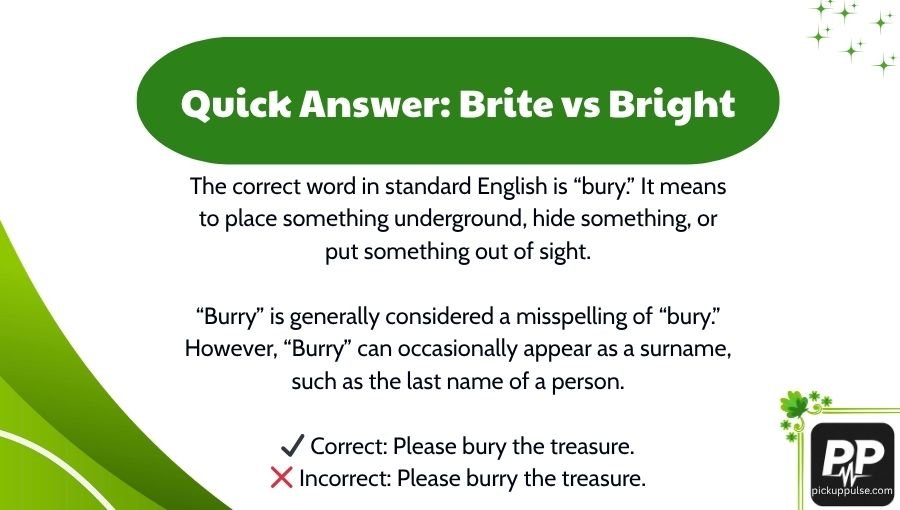
The correct word in standard English is “bury.” It means to place something underground, hide something, or put something out of sight.
“Burry” is generally considered a misspelling of “bury.” However, “Burry” can occasionally appear as a surname, such as the last name of a person.
✔ Correct: Please bury the treasure.
❌ Incorrect: Please burry the treasure.
Understanding the Basics of Burry or Bury
The confusion between burry and bury comes mainly from pronunciation. The word “bury” is pronounced like “berry,” which can trick people into adding an extra “r.”
Core Difference
- Bury = Correct English verb
- Burry = Usually incorrect spelling
Comparison Table: Burry vs Bury
| Form | Type | Meaning | Example | Correct/Incorrect |
|---|---|---|---|---|
| Bury | Verb | To place underground or hide | “They will bury the box.” | ✅ Correct |
| Burry | Misspelling/Surname | Usually an incorrect spelling | “Please burry it.” | ❌ Incorrect |
| Burry | Proper Noun | A family name | “Michael Burry is an investor.” | ✅ Correct as a name |
Correct Meanings & Uses of “Bury” 🪦
What Does “Bury” Mean?
The verb bury has several meanings depending on context.
1. To Place Something Underground
This is the most common meaning.
Examples
- They will bury the treasure near the tree.
- The villagers buried the time capsule.
- We buried the seeds in the garden.
Sentence Breakdown
| Sentence Part | Explanation |
|---|---|
| They | Subject |
| will bury | Verb phrase |
| the treasure | Object |
| near the tree | Location phrase |
Test Tip ✅
If the sentence involves putting something into the ground, use bury.
2. To Hide Something
“Bury” can also mean hiding something physically or emotionally.
Examples
- She buried her face in her hands.
- He buried the documents in a drawer.
- Many people bury their emotions.
Test Tip ✅
If the meaning involves hiding, covering, or concealing, the correct word is still bury.
3. To Cover Completely
Sometimes “bury” means overwhelming or covering something entirely.
Examples
- Snow buried the small village.
- Homework buried the students this weekend.
- Emails buried the important message.
Test Tip ✅
If something is covered or overwhelmed, “bury” fits correctly.
Is “Burry” Ever Correct? 🤷
In grammar and standard dictionary usage, “burry” is usually incorrect. However, there are rare exceptions.
Proper Noun Usage
“Burry” may appear as:
- A surname
- A company name
- A place name
Example
- Michael Burry became famous after predicting the 2008 financial crisis.
In this case, “Burry” is a proper name, not a grammar word.
Grammar Rules Explanation 📖
According to standard English dictionaries like Merriam-Webster, the correct spelling is bury.
Why “Bury” Is Correct
English verbs often follow historical spelling patterns. The word “bury” comes from Old English and has maintained its spelling over time.
Even though it sounds similar to “berry,” the spelling remains:
- B-U-R-Y
Not:
- B-U-R-R-Y
Pronunciation Confusion
Pronunciation
Bury → pronounced as BEH-ree or BER-ee
Because the pronunciation sounds similar to words with double “r,” many people mistakenly write “burry.”
Verb Conjugation Table
| Tense | Correct Form |
|---|---|
| Present | bury |
| Past | buried |
| Present Participle | burying |
| Future | will bury |
Examples
- I bury old letters.
- She buried the gift.
- They are burying the evidence.
- We will bury the capsule tomorrow.
Case Study Section 📝
Workplace Email Example
Imagine an employee sending this email:
❌ Incorrect Version:
“Please burry the old project files in the archive folder.”
This sentence contains a spelling mistake that may reduce professionalism.
Correct Version
✅ Correct:
“Please bury the old project files in the archive folder.”
Now the sentence appears polished and grammatically accurate.
Why This Matters
In professional communication:
- Small spelling mistakes affect credibility
- Correct grammar builds trust
- Clear writing improves understanding
Common Mistakes With Burry or Bury ❌
People confuse these words for several reasons.
1. Fast Typing
When typing quickly, users often double letters accidentally.
Example
- Typing “burry” instead of “bury”
2. Autocorrect Issues
Sometimes devices incorrectly predict spellings.
3. Pronunciation Confusion
Since “bury” sounds like “berry,” writers may assume it needs double “r.”
4. Lack of Grammar Knowledge
Some writers simply never learned the correct spelling rule.
Table of Similar Grammar Confusions 📊
| Incorrect | Correct | Reason for Confusion |
|---|---|---|
| Burry | Bury | Pronunciation |
| Its | It’s | Apostrophe confusion |
| Your | You’re | Similar pronunciation |
| Loose | Lose | Spelling similarity |
| Then | Than | Fast typing |
| Affect | Effect | Similar meanings |
| Weather | Whether | Homophone confusion |
Usage in Different Contexts 🌍
Everyday Conversation
In casual speech, people commonly use “bury.”
Examples
- “Let’s bury the box in the backyard.”
- “Don’t bury your feelings.”
Professional Writing
Correct spelling matters more in formal settings.
Examples
- Reports
- Emails
- Presentations
- Academic writing
Professional Example
- “The company decided to bury outdated policies.”
Creative Writing ✍️
Authors use “bury” in emotional and descriptive ways.
Examples
- “She buried her dreams beneath years of fear.”
- “The storm buried the town in snow.”
Social Media & Texting 📱
Mistakes appear frequently online because people type quickly.
Incorrect Post
- “I’m going to burry my phone after this update.”
Correct Post
- “I’m going to bury my phone after this update.”
Why It Matters 💡
Correct spelling is not just about grammar rules. It shapes how people understand and judge your writing.
1. Clarity in Communication
Correct words prevent confusion.
2. Professionalism
Proper spelling improves credibility at work and school.
3. Better Digital Communication
In today’s online world, accurate spelling matters in:
- Emails
- Blogs
- Social media
- Text messages
- Online applications
4. Stronger Writing Skills
Learning correct word forms improves overall English ability.
Inspirational Quote ✨
“Good writing is clear thinking made visible.”
Special Exception ⚠️
When “Burry” Is Acceptable
The spelling “Burry” may be correct if it refers to:
- A surname
- A brand
- A company
- A fictional character
Example
- Michael Burry is a well-known financial expert.
Outside these special cases, use bury.
Quick Recap Checklist ✅
Which Word Should You Use?
| Question | If Yes → Use |
|---|---|
| Are you talking about hiding something? | Bury |
| Are you talking about putting something underground? | Bury |
| Is it a person’s last name? | Burry |
| Are you writing standard English grammar? | Bury |
Practice Examples
Example 1
- Correct: “Please bury the note.”
- Incorrect: “Please burry the note.”
Example 2
- Correct: “The snow buried the road.”
- Incorrect: “The snow burry the road.”
Example 3
- Correct: “Do not bury your emotions.”
- Incorrect: “Do not burry your emotions.”
Deep Dive Into the Word “Bury” 🔍
Historical Background
The word “bury” comes from Old English roots connected to:
- graves
- covering
- protection
- concealment
Over time, the spelling stayed mostly unchanged even while pronunciation evolved.
This is common in English because many spellings reflect historical language patterns rather than modern pronunciation.
Common Expressions Using “Bury” 📚
1. Bury the Hatchet
Meaning
To end an argument or conflict.
Example
- “After years of fighting, they finally buried the hatchet.”
2. Bury Your Head in the Sand
Meaning
To ignore problems.
Example
- “You cannot bury your head in the sand forever.”
3. Buried in Work
Meaning
Extremely busy.
Example
- “I’m buried in assignments today.”
Memory Tricks to Remember the Correct Spelling 🧠
Trick 1: One “R” Rule
The correct spelling has:
- One “R”
- One action
Bury = One “R”
Trick 2: Match With “Buried”
Notice:
- bury → buried
- not burry → burrried
The incorrect form looks awkward when conjugated.
Trick 3: Dictionary Check
If uncertain, quickly check a trusted dictionary source like:
Bury in Literature and Media 🎬
Writers and filmmakers often use “bury” symbolically.
Emotional Symbolism
“Bury” can represent:
- hiding pain
- forgetting memories
- suppressing emotions
- ending the past
Example in Fiction
- “He buried the secret deep within his heart.”
This usage creates emotional depth and dramatic effect.
How Search Engines Interpret “Burry or Bury” 🔎
Many people search:
- “Is burry correct?”
- “Burry or bury meaning”
- “How to spell bury”
- “Burry spelling mistake”
Search engines understand this as a grammar confusion query and usually direct users toward the correct word: bury.
Mini Grammar Quiz 🧪
Choose the correct word.
1.
“We will ___ the treasure tonight.”
✅ Answer: bury
2.
“She tried to ___ her feelings.”
✅ Answer: bury
3.
“Michael ___ predicted the market crash.”
✅ Answer: Burry
Because it is a surname.
Expert Writing Tips ✨
Always Proofread
Before sending important writing:
- Check spelling
- Read aloud
- Use grammar tools
Learn Commonly Confused Words
Improving vocabulary reduces future mistakes.
Slow Down While Typing
Many spelling errors happen because of speed.
FAQs About Burry or Bury ❓
1. Is “burry” a real word?
Usually, no. “Burry” is generally considered a misspelling of “bury.” However, it can be a surname or proper noun.
2. Which spelling is correct: bury or burry?
The correct spelling in English grammar is bury.
3. Why do people write “burry” by mistake?
People confuse the pronunciation because “bury” sounds similar to “berry.”
4. Can “Burry” ever be correct?
Yes, when used as a name, such as Michael Burry.
5. What does “bury” mean?
“Bury” means:
- to place underground
- to hide
- to cover completely
6. How can I remember the correct spelling?
Remember this simple rule:
“Bury has only one R.”
Final Thoughts on Burry or Bury 🏁
The confusion between “Burry or Bury” is common, but the rule is actually simple once you understand it clearly. In standard English grammar, bury is the correct spelling when talking about hiding, covering, or placing something underground. The form burry is usually a spelling mistake, except when used as a surname or proper noun.
Mastering small grammar differences like this can greatly improve your writing quality, professionalism, and communication skills. Whether you are writing an email, creating social media content, working on academic assignments, or simply texting friends, using the correct spelling makes your message clearer and more polished.
The next time you hesitate between “burry” and “bury,” remember this easy rule:
✅ If it is the verb, use “bury.”
✅ If it is a person’s name, “Burry” may be correct.
Small spelling choices create big writing improvements. Keep learning, keep practicing, and your English skills will continue to grow every day. 🚀
Also Read This: Trapway Meaning

Hi, I’m Zyler Knox, an expert in names and unique nickname creation. I specialize in developing fresh, modern, and expressive nicknames that add personality to every name.