Complete or Completed: Which Word Should You Use? ✅📘
Have you ever paused while writing a sentence and wondered whether to use complete or completed? 🤔 You are not alone. Many English learners and even native speakers get confused between these two words because they look similar and are closely related in meaning.
The confusion usually happens in sentences like:
- “The project is complete.”
- “The project is completed.”
At first glance, both seem correct. However, they are not always interchangeable. One acts mainly as an adjective, while the other often functions as a verb form or participial adjective. Choosing the wrong one can make your writing sound awkward or grammatically incorrect.
Understanding the difference between complete or completed is important for writing emails, school assignments, professional reports, and everyday conversations. ✍️
In this guide, you will learn:
- The exact meaning of each word
- When to use “complete”
- When to use “completed”
- Common mistakes to avoid
- Real-life examples
- Easy grammar rules and memory tricks
By the end, you will confidently know which word fits your sentence perfectly. 🚀
Quick Answer: Complete or Completed
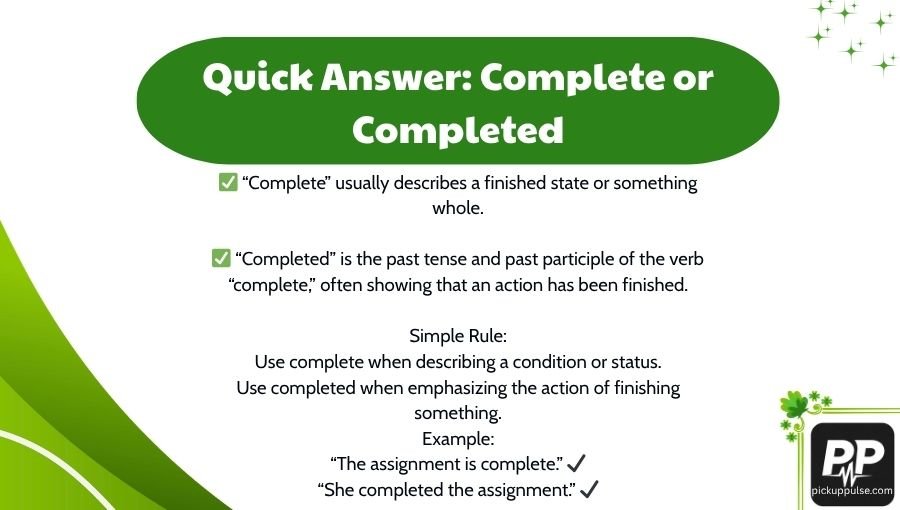
✅ “Complete” usually describes a finished state or something whole.
✅ “Completed” is the past tense and past participle of the verb “complete,” often showing that an action has been finished.
Simple Rule:
- Use complete when describing a condition or status.
- Use completed when emphasizing the action of finishing something.
Example:
- “The assignment is complete.” ✔️
- “She completed the assignment.” ✔️
Understanding the Basics of Complete or Completed
To fully understand the difference, let’s break down each word separately.
What Does “Complete” Mean?
The word complete can function as:
- An adjective
- A verb
- Occasionally a noun in specialized contexts
Most commonly, it means:
- Finished
- Whole
- Having all parts
Examples:
- “The report is complete.” 📄
- “This is a complete guide.”
- “Please complete the form.”
What Does “Completed” Mean?
Completed is the past tense and past participle form of the verb complete.
It refers to an action that has already been finished.
Examples:
- “He completed the task yesterday.”
- “The construction was completed in 2025.”
Comparison Table: Complete or Completed
| Form | Type | Meaning | Example | Correct/Incorrect |
|---|---|---|---|---|
| Complete | Adjective | Finished or whole | “The work is complete.” | ✔️ Correct |
| Complete | Verb | To finish something | “Please complete the survey.” | ✔️ Correct |
| Completed | Past tense verb | Finished an action | “She completed the exam.” | ✔️ Correct |
| Completed | Past participle adjective | Something has been finished | “The completed form was submitted.” | ✔️ Correct |
| Completed instead of complete | Wrong in some contexts | Sounds unnatural | “The work is completed.” | ⚠️ Sometimes awkward |
Correct Meanings & Uses
Using “Complete” Correctly ✅
“Complete” is commonly used as an adjective to describe something that is already finished or whole.
Examples:
- “The meal is complete.”
- “Your application is complete.”
- “This is a complete collection.”
Sentence Breakdown
Example:
“The application is complete.”
- “Application” = noun
- “is” = linking verb
- “complete” = adjective describing the noun
Here, “complete” tells us the state of the application.
Test Tip 🧠
Ask yourself:
“Am I describing the condition of something?”
If yes, use complete.
Using “Completed” Correctly ✅
“Completed” emphasizes that an action of finishing occurred.
Examples:
- “She completed the training.”
- “The engineers completed the bridge.”
- “The completed document was uploaded.”
Sentence Breakdown
Example:
“She completed the training.”
- “She” = subject
- “completed” = action verb
- “training” = object
This sentence focuses on the action of finishing.
Test Tip 🧠
Ask yourself:
“Am I talking about an action that happened?”
If yes, use completed.
When Both Can Appear Correct
Sometimes both words are grammatically possible, but one sounds more natural.
Example:
- “The project is complete.” ✔️ Natural
- “The project is completed.” ✔️ Grammatically possible but less natural
Why?
Because English speakers usually prefer complete when describing a current state.
“Completed” often sounds passive or overly formal.
Case Study Section 📚
Workplace Email Example
Incorrect Version ❌
“The monthly report is completed.”
This sentence is not technically wrong, but it sounds stiff and unnatural in everyday business English.
Better Version ✅
“The monthly report is complete.”
This sounds smoother and more professional.
Conversation Example
Natural Dialogue:
Manager: “Is the presentation ready?”
Employee: “Yes, it’s complete.” ✔️
Less Natural:
Employee: “Yes, it’s completed.” ⚠️
Native speakers rarely say this unless emphasizing the action itself.
School Assignment Example
Correct:
- “I completed my homework.”
- “My homework is complete.”
Both are correct because they serve different purposes.
Grammar Rules Explanation 📖
According to standard English grammar references like Merriam-Webster, the word complete primarily functions as both:
- An adjective
- A verb
Meanwhile, completed is specifically the past tense and past participle form of the verb.
Key Grammar Rule
Use “Complete”:
- After linking verbs like:
- is
- are
- was
- were
- seems
- becomes
Examples:
- “The file is complete.”
- “The puzzle was complete.”
Use “Completed”:
- For past actions
- In passive voice
- As a participial adjective
Examples:
- “She completed the assignment.”
- “The bridge was completed last year.”
Why “The Project Is Completed” Sounds Different
This structure uses the passive voice.
Structure:
- Subject + be verb + past participle
Example:
- “The project is completed.”
This emphasizes the process of completion rather than the current state.
In modern English, people usually simplify it to:
- “The project is complete.”
Common Mistakes ⚠️
Why Do People Confuse Complete and Completed?
Several reasons cause this confusion:
1. Fast Typing ⌨️
People quickly choose the longer form without thinking about grammar.
2. Autocorrect 📱
Phones and software may suggest the wrong version.
3. Lack of Grammar Knowledge 📚
Many learners do not know the difference between adjectives and participles.
4. Translation Issues 🌍
Other languages may use only one form for both meanings.
Common Mistake Examples
| Incorrect | Correct | Reason |
|---|---|---|
| “The task is completed.” | “The task is complete.” | Better adjective choice |
| “I complete the task yesterday.” | “I completed the task yesterday.” | Needs past tense |
| “The form completed.” | “The form is complete.” | Missing linking verb |
Similar Grammar Confusions
| Confusing Words | Correct Usage |
|---|---|
| It’s / Its | “It’s raining” vs “Its color” |
| Your / You’re | “Your book” vs “You’re late” |
| Affect / Effect | Verb vs noun |
| Then / Than | Time vs comparison |
| Complete / Completed | State vs finished action |
Usage in Different Contexts 🌎
Everyday Conversation
In daily speech, “complete” is more common when describing status.
Examples:
- “Dinner is complete.”
- “Your profile is complete.”
Professional Writing 💼
Business communication often prefers concise wording.
Better:
- “The audit is complete.”
Less Preferred:
- “The audit is completed.”
Academic Writing 🎓
Academic writing may use both forms depending on emphasis.
Examples:
- “Researchers completed the study.”
- “The study is complete.”
Creative Writing ✍️
Writers use whichever form better matches tone and rhythm.
Example:
- “At last, the journey was complete.”
This sounds more emotional and polished.
Social Media & Texting 📱
People usually prefer shorter wording online.
Common Usage:
- “Mission complete!” 🚀
- “Homework completed.” ✔️
Both can work stylistically in short messages.
Why It Matters 🌟
Choosing between complete or completed may seem small, but it affects communication quality in major ways.
1. Clarity
Correct grammar makes your message easier to understand.
Example:
- “The application is complete.” ✔️
- Cleaner and clearer.
2. Professionalism 💼
Using the right word improves professional writing.
Employers, teachers, and clients notice grammar accuracy.
3. Better Digital Communication 🌐
In emails, reports, and online messaging, precise wording builds credibility.
4. Stronger Writing Skills ✍️
Understanding grammar patterns improves overall English fluency.
Short Quote 💬
“Clear grammar creates clear communication.”
Special Exception 🚨
There are some rare situations where completed is preferred even after “is.”
Passive Voice Situations
When emphasizing that an action was carried out by someone or something.
Example:
- “The bridge is completed by the construction team.”
Although this sentence sounds formal, it highlights the action.
Technical or Legal Writing
Some industries use passive structures more often.
Example:
- “The installation is completed according to safety regulations.”
In everyday English, however, “installation is complete” sounds more natural.
Quick Recap Checklist ✅
| Question | If Yes → Use |
|---|---|
| Are you describing a finished state? | Complete |
| Are you describing an action already done? | Completed |
| Is it after “is/are/was/were”? | Usually Complete |
| Is it a past-tense action? | Completed |
| Are you emphasizing the process? | Completed |
Practice Examples 📝
1.
“The assignment is ____.”
✅ Answer: complete
2.
“She ____ the assignment yesterday.”
✅ Answer: completed
3.
“The construction project was ____ in May.”
✅ Answer: completed
Advanced Usage Notes 📘
“Complete” as a Verb
Sometimes learners forget that “complete” itself can be a verb.
Examples:
- “Please complete the registration.”
- “Complete the sentence.”
Here, it means:
To finish something.
“Completed” as an Adjective
“Completed” can occasionally describe nouns.
Examples:
- “The completed worksheet”
- “A completed application form”
This is acceptable because the word acts as a participial adjective.
Memory Trick 🧠✨
Here’s an easy way to remember:
Complete = Condition
Think:
“It is complete.”
This describes a state.
Completed = Action Finished
Think:
“Someone completed it.”
This describes an action.
Frequently Asked Questions (FAQs)
1. Is it correct to say “task completed”?
Yes. ✅
“Task completed” is a shortened expression commonly used in notifications, labels, or casual communication.
Example:
- “Upload completed.”
- “Mission completed.”
2. Which sounds more natural: “The work is complete” or “The work is completed”?
“The work is complete” sounds more natural in everyday English.
“The work is completed” is grammatically correct but more formal or passive.
3. Can “complete” be used as a verb?
Yes. ✅
Example:
- “Please complete the survey.”
Here, “complete” means “finish.”
4. Why do native speakers prefer “complete”?
Because English often favors simpler adjective structures over passive constructions.
Example:
- “The project is complete” sounds cleaner than “The project is completed.”
5. Is “completed” always wrong after “is”?
No. ❌
It is grammatically correct in passive voice.
Example:
- “The bridge is completed by engineers.”
However, it may sound overly formal in casual writing.
6. What is the easiest rule to remember?
Simple Rule:
- Complete = state or condition
- Completed = finished action
Final Comparison Table 📊
| Sentence | Best Choice |
|---|---|
| “The homework is ___.” | Complete |
| “She ___ the homework.” | Completed |
| “The form is ___.” | Complete |
| “The project was ___ yesterday.” | Completed |
| “Please ___ the survey.” | Complete |
Conclusion
Understanding the difference between complete or completed is easier once you know the grammar behind each word. ✅
Use complete when describing a finished state, condition, or something whole. Use completed when talking about the action of finishing something or when using the past tense.
Remember these simple examples:
- “The work is complete.” ✔️
- “She completed the work.” ✔️
Although both words come from the same root, they serve different grammatical purposes. Choosing the correct form improves clarity, professionalism, and confidence in your writing. ✍️
The next time you hesitate between complete or completed, just ask yourself:
“Am I describing a state or an action?”
That one question will help you choose the correct word every time. 🚀
Also Read This: Targeting vs Targetting

Hi, I’m Daxter Wilde, an expert in names who enjoys designing creative and distinctive nicknames. My goal is to turn simple names into something fun, memorable, and full of character.