Targeting vs Targetting: Which Spelling Is Correct? 🎯
Have you ever typed “targetting” in an email or social media post and suddenly noticed that red spell-check underline? 🤔 You are not alone. Many English writers get confused between targeting vs targetting because both words seem like they should be correct.
The confusion usually comes from English spelling rules. Sometimes we double the final consonant before adding “-ing,” and sometimes we do not. Words like “running” and “swimming” follow one pattern, while words like “targeting” follow another. Because of this inconsistency, many people accidentally write “targetting” instead of the correct spelling.
In modern American English, “targeting” is the correct spelling. The form “targetting” is considered incorrect in standard US grammar and professional writing. Understanding this small difference can improve your writing clarity, professionalism, and credibility. ✍️
This guide will explain everything you need to know about targeting vs targetting, including grammar rules, real-life examples, common mistakes, usage tips, and practical writing advice.
Quick Answer: Targeting vs Targetting 🎯
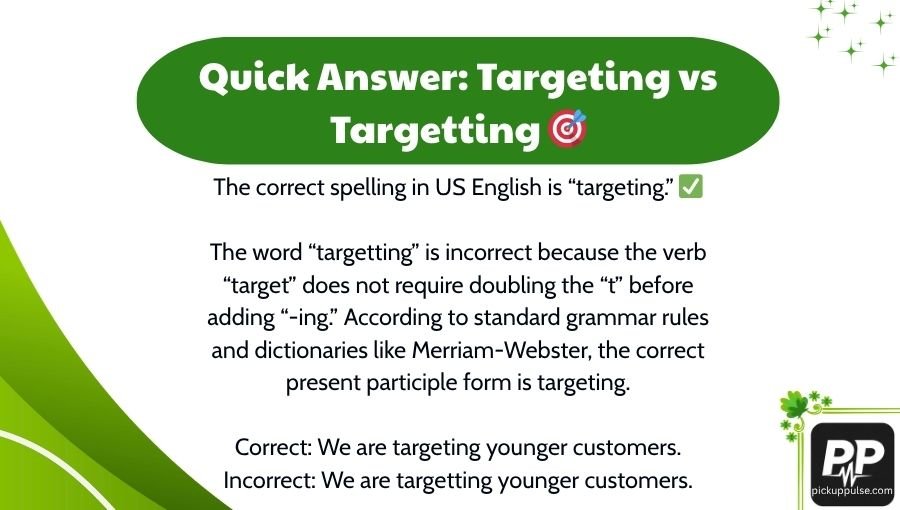
The correct spelling in US English is “targeting.” ✅
The word “targetting” is incorrect because the verb “target” does not require doubling the “t” before adding “-ing.” According to standard grammar rules and dictionaries like Merriam-Webster, the correct present participle form is targeting.
Correct: We are targeting younger customers.
Incorrect: We are targetting younger customers.
Understanding the Basics of Targeting vs Targetting
The confusion between these two spellings comes from English verb formation rules. Let’s simplify it.
The base word is:
Target = noun or verb
When adding “-ing,” many English words simply add the suffix without changing the spelling.
So:
Target + ing = targeting ✅
Not:
Target + ting = targetting ❌
Comparison Table
| Form | Type | Meaning | Example | Correct/Incorrect |
|---|---|---|---|---|
| Targeting | Verb (present participle) | Focusing on a goal or audience | The company is targeting teens. | ✅ Correct |
| Targetting | Misspelling | Incorrect spelling of targeting | She is targetting customers. | ❌ Incorrect |
Correct Meanings & Uses
What Does “Targeting” Mean? 🎯
The word targeting means focusing attention, effort, or action toward a specific person, group, object, or goal.
It is commonly used in:
- Marketing
- Business
- Advertising
- Sports
- Military language
- Everyday communication
Example 1: Marketing
“The brand is targeting young adults through social media.”
Sentence Breakdown
- The brand = subject
- is targeting = action happening now
- young adults = intended audience
This sentence means the company is focusing its marketing efforts on young adults.
Example 2: Everyday Use
“She is targeting better grades this semester.”
This means she is aiming for academic improvement.
Why “Targetting” Is Incorrect ❌
The spelling targetting incorrectly doubles the final “t.”
English grammar rules only double the final consonant in certain situations, such as:
- One-syllable words
- Stress on the final syllable
Examples:
- Run → running
- Sit → sitting
However, “target” does not follow that pattern.
Correct Formation
- Target → targeting ✅
- Target → targetted ❌
- Target → targetting ❌
Test Tip 📝
If the original word ends with two syllables and the stress is not on the last syllable, do not double the final consonant before adding “-ing.”
Compare These Examples
| Base Word | Correct Form |
|---|---|
| Visit | Visiting |
| Target | Targeting |
| Open | Opening |
| Edit | Editing |
Notice that none of these double the final consonant.
Case Study Section 📚
Workplace Email Example
Imagine a marketing manager writing this sentence:
❌ “We are targetting customers between ages 18 and 25.”
This spelling mistake may seem small, but it can affect professionalism. Clients or coworkers may notice the error immediately.
Correct Version
✅ “We are targeting customers between ages 18 and 25.”
Why It Matters
In business communication:
- Correct spelling builds trust
- Professional writing improves credibility
- Errors can distract readers
Even a tiny spelling mistake can weaken a strong message.
Grammar Rules Explanation 📖
Why Is “Targeting” Correct?
According to standard grammar rules and references like Merriam-Webster, verbs ending in consonants do not always double the last letter before adding “-ing.”
The Doubling Rule
You usually double the final consonant when:
- The word has one syllable
- The vowel before the consonant is short
- The stress falls on the final syllable
Examples
| Word | Correct Form |
|---|---|
| Run | Running |
| Sit | Sitting |
| Stop | Stopping |
But “target” has two syllables:
Tar-get
The stress is on the first syllable, not the second.
Therefore:
✅ Targeting
❌ Targetting
British English vs American English 🌍
Some English words differ between British and American spelling.
For example:
| American English | British English |
|---|---|
| Traveling | Travelling |
| Counseling | Counselling |
However, even in British English, “targeting” remains the standard accepted spelling in most dictionaries and style guides.
Common Mistakes ⚠️
Why Do People Write “Targetting”?
Several factors cause this mistake.
1. Fast Typing ⌨️
People often type quickly and accidentally double letters.
2. Autocorrect Problems 📱
Some devices incorrectly predict spellings based on typing habits.
3. Lack of Grammar Knowledge 📘
Many writers do not fully understand consonant-doubling rules.
4. Influence of Other Words
Words like “running” or “shopping” make people assume all verbs need doubled consonants.
Similar Grammar Confusions
| Confusing Words | Correct Form | Common Error |
|---|---|---|
| It’s / Its | Depends on meaning | Apostrophe confusion |
| Your / You’re | Depends on grammar | Missing contraction |
| Affect / Effect | Depends on usage | Meaning confusion |
| Targeting / Targetting | Targeting | Extra “t” |
| Occurred / Ocurred | Occurred | Missing consonant |
| Separate / Seperate | Separate | Vowel confusion |
Usage in Different Contexts 🌍
Everyday Conversation
People often use “targeting” casually in speech and writing.
Examples
- “I’m targeting a healthier lifestyle.”
- “They are targeting more savings this year.”
Professional Writing 💼
In workplaces, the word commonly appears in:
- Business reports
- Marketing plans
- Emails
- Presentations
Example
“Our campaign is targeting international customers.”
Correct spelling is especially important in professional communication.
Creative Writing ✍️
Authors may use “targeting” in stories, novels, or scripts.
Example
“The hunter was targeting the deer carefully.”
Social Media and Texting 📱
Online users often type quickly, which increases spelling mistakes.
Incorrect Social Media Example
❌ “This ad is targetting gamers.”
Correct Version
✅ “This ad is targeting gamers.”
Even casual writing benefits from proper spelling.
Why It Matters 🎯
Some people think spelling mistakes are unimportant. However, correct spelling affects communication more than many realize.
1. Clarity in Communication
Correct spelling makes messages easier to understand.
Readers should focus on your ideas—not your errors.
2. Professionalism 💼
Employers, clients, and teachers notice spelling accuracy.
Correct writing shows:
- Attention to detail
- Education
- Professional standards
3. Digital Communication Accuracy 🌐
Today, most communication happens online.
Misspellings can affect:
- Emails
- Social media posts
- Website content
- SEO rankings
- Marketing campaigns
Search engines also favor professionally written content.
Short Quote ✨
“Good writing is clear thinking made visible.”
This quote reminds us that correct spelling improves how ideas are received.
Special Exception 🔍
There are very few exceptions involving the word “targeting.”
Brand or Stylized Spellings
Sometimes companies intentionally misspell words for branding purposes.
For example:
- Product names
- App titles
- Gaming usernames
A fictional brand might use “Targetting” stylistically. However, this does not make it grammatically correct in standard English.
Important Reminder
Use “targeting” in:
- Academic writing
- Professional documents
- Emails
- Essays
- Articles
- Formal communication
Quick Recap Checklist ✅
Simple Rule Table
| Question | If Yes → Use |
|---|---|
| Are you adding “-ing” to “target”? | Targeting |
| Is the stress on the first syllable? | Do not double “t” |
| Are you writing professionally? | Targeting |
| Are you unsure which spelling is correct? | Targeting |
Practice Examples 📝
Example 1
✅ The company is targeting parents.
❌ The company is targetting parents.
Example 2
✅ She is targeting a promotion.
❌ She is targetting a promotion.
Example 3
✅ They are targeting new markets.
❌ They are targetting new markets.
Detailed Examples of Correct Usage
Marketing Context 📈
“Advertisers are targeting mobile users through social media campaigns.”
Meaning:
The advertisers are focusing their efforts on mobile users.
Sports Context ⚽
“The striker was targeting the top corner of the goal.”
Meaning:
The player aimed carefully at a specific area.
Education Context 🎓
“The student is targeting higher test scores.”
Meaning:
The student aims to improve academically.
Technology Context 💻
“The software update is targeting security issues.”
Meaning:
The update focuses on fixing security problems.
Memory Tricks to Remember the Correct Spelling 🧠
Trick #1: Think of Similar Words
Compare these words:
- Edit → editing
- Visit → visiting
- Target → targeting
None of them double the final consonant.
Trick #2: Stress Rule
Say the word aloud:
TAR-get
The stress is at the beginning.
Words stressed at the beginning usually do not double the final consonant before “-ing.”
Trick #3: Use Spell Check Carefully
Modern spell-check tools often catch “targetting.”
Still, learning the rule yourself is better than depending entirely on software.
SEO and Digital Marketing Usage 📊
The word “targeting” appears frequently in digital marketing.
Common phrases include:
- Audience targeting
- Behavioral targeting
- Ad targeting
- Keyword targeting
- Customer targeting
These are important concepts in online advertising.
Example
“Keyword targeting helps websites reach the right audience.”
Because the term is so common in business and SEO, spelling accuracy is extremely important.
Educational Perspective 📚
Teachers often correct spelling mistakes like “targetting” because they reflect misunderstanding of grammar structure.
Learning the correct form helps students improve:
- Essays
- Assignments
- Exams
- Professional writing skills
Strong grammar habits also improve confidence in communication.
Historical Language Influence 🌍
English spelling rules developed from many language influences, including:
- Latin
- French
- Germanic languages
This is why some spelling rules appear inconsistent.
For example:
- Run → running
- Open → opening
- Begin → beginning
- Target → targeting
The best approach is learning patterns through practice and exposure.
Frequently Asked Questions (FAQs) ❓
Is “targetting” ever correct?
No. In standard American English, “targetting” is considered a misspelling. The correct form is “targeting.”
Why doesn’t “target” double the “t”?
Because the stress is on the first syllable (“TAR-get”), English grammar rules do not require doubling the final consonant.
Is “targeting” used in British English too?
Yes. Both American and British English commonly use “targeting” as the standard spelling.
What part of speech is “targeting”?
“Targeting” is usually a verb in present participle form, but it can also function as a noun in certain contexts.
Example
“Targeting customers effectively improves sales.”
Why do people confuse targeting vs targetting?
People often assume all verbs double the final consonant before adding “-ing.” Fast typing and autocorrect also contribute to the confusion.
How can I avoid spelling mistakes like this?
You can improve accuracy by:
- Learning grammar rules
- Reading regularly
- Using spell-check tools
- Proofreading carefully
- Practicing common word patterns
Final Thoughts on Targeting vs Targetting 🎯
The difference between targeting vs targetting is simple once you understand the grammar rule behind it. The correct spelling is always “targeting.” The form “targetting” is considered incorrect in standard English writing.
Remember this key rule:
✅ If the stress is not on the final syllable, you usually do not double the last consonant before adding “-ing.”
Using the correct spelling improves:
- Professionalism
- Clarity
- Writing quality
- Communication accuracy
Whether you are writing emails, essays, business reports, social media posts, or marketing content, spelling matters. Small details can make a big difference in how readers perceive your message.
The next time you type the word, remember:
🎯 You target a goal, so you write “targeting” — never “targetting.”
Also Read This: What Does Green Mean on a Mood Ring

Hi, I’m Rylan Dorsey, a creative wordsmith who loves crafting pick-up lines, puns, and nicknames. At PickupPulse.com, I share fun, original content designed to entertain and bring a smile.