Hola or Ola: What’s the Difference and Which One Should You Use? 😊
Have you ever been unsure whether to type “hola or ola” when greeting someone or writing a message? This tiny spelling difference confuses many learners of Spanish and Portuguese, especially when switching quickly between languages. At first glance, both words look almost the same, but they have completely different meanings and uses.
The confusion around hola or ola is very common in digital communication, where fast typing and autocorrect can easily lead to mistakes. One is a friendly greeting used in Spanish, while the other refers to a wave in water. Mixing them up might seem small, but it can completely change the meaning of your sentence.
In this guide, we will clearly break down the difference between hola or ola, how to use each one correctly, and how to avoid common mistakes. By the end, you’ll be able to use both words with full confidence in any context. 🚀
Quick Answer Section: Hola or Ola
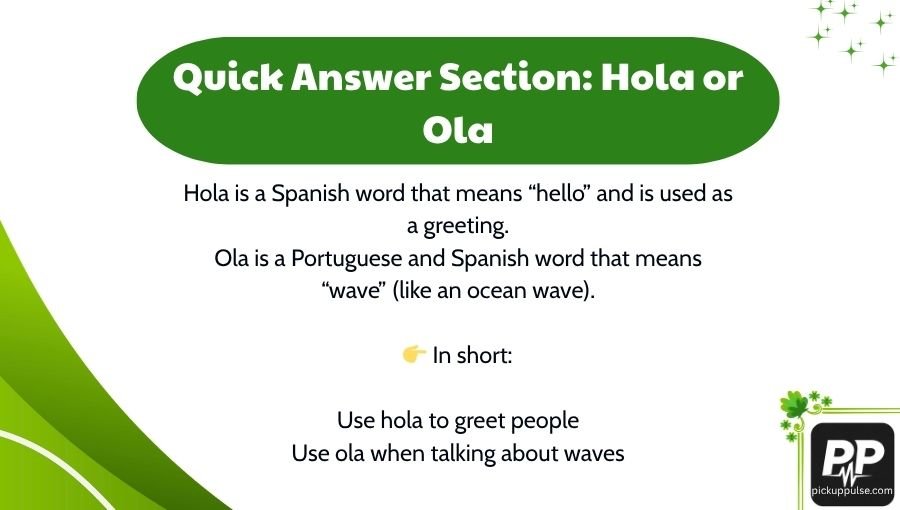
Hola is a Spanish word that means “hello” and is used as a greeting.
Ola is a Portuguese and Spanish word that means “wave” (like an ocean wave).
👉 In short:
- Use hola to greet people
- Use ola when talking about waves
Understanding the Basics: Hola or Ola
The confusion between hola or ola comes down to one missing letter: the letter “h.” However, that small difference changes everything.
Core Difference
- Hola → Greeting (Spanish)
- Ola → Noun (wave, in Portuguese and Spanish contexts)
Comparison Table
| Form | Type | Meaning | Example Sentence | Correct/Incorrect |
|---|---|---|---|---|
| Hola | Interjection | Hello (greeting) | Hola, ¿cómo estás? | ✅ Correct |
| Ola | Noun | Wave (water motion) | La ola es muy grande | ✅ Correct |
| Ola | Greeting | Misused greeting | Ola, ¿cómo estás? | ❌ Incorrect |
| Hola | Wave meaning | Misused noun | La hola es fuerte | ❌ Incorrect |
Correct Meanings & Uses
H3: What Does “Hola” Mean?
Hola is a Spanish greeting used to say “hello.” It is one of the most basic and widely used words in Spanish.
Examples:
- Hola, amigo.
- Hola, ¿cómo estás?
- Hola, buenos días.
Sentence Breakdown:
- Hola = Hello
- ¿cómo estás? = How are you?
👉 This shows that “hola” is always used at the beginning of a greeting.
✅ Test Tip:
If you are greeting a person, always choose hola, not ola.
H3: What Does “Ola” Mean?
Ola means “wave” in Spanish and Portuguese. It refers to the movement of water in the ocean.
Examples:
- La ola es muy alta. (The wave is very tall.)
- La ola golpeó la costa. (The wave hit the shore.)
Sentence Breakdown:
- La ola = The wave
- es muy alta = is very tall
👉 Notice that “ola” is used as a noun, not as a greeting.
✅ Test Tip:
If you are talking about the ocean, water, or movement, use ola.
Case Study Section
Real-Life Example: Text Message Confusion 📱
Scenario:
Maria, who is learning Spanish, sends a message to her friend:
“Ola, how are you?”
Her friend replies:
“Do you mean hola or are we talking about waves? 😄”
What Went Wrong?
Maria accidentally used ola instead of hola. While the message is understandable, it looks incorrect and slightly confusing.
Correct Version:
“Hola, how are you?”
Lesson Learned:
- Small spelling differences matter
- Autocorrect may not always fix the issue
- Knowing the correct word improves clarity
Grammar Rules Explanation
From a grammar perspective, hola or ola differ in both function and origin.
According to Merriam-Webster:
- Hola is classified as an interjection (used as a greeting)
- Ola is a noun (refers to a wave)
Key Grammar Points:
- Hola
- Part of speech: Interjection
- Function: Express greeting
- Always stands alone or at sentence start
- Ola
- Part of speech: Noun
- Function: Represents an object (wave)
- Used within a sentence
👉 This grammatical distinction is why they cannot be used interchangeably.
Common Mistakes
Why Do People Confuse Hola and Ola?
Several factors contribute to this mistake:
- Fast typing
- Autocorrect errors
- Lack of language knowledge
- Similar spelling
Common Confusion Table
| Confusing Pair | Correct Usage Example | Mistake Reason |
|---|---|---|
| Hola / Ola | Hola, amigo | Missing letter |
| It’s / Its | It’s raining | Apostrophe confusion |
| Your / You’re | You’re welcome | Sound similarity |
| There / Their | Their house is big | Spelling similarity |
| Affect / Effect | Effect of change | Meaning confusion |
👉 These mistakes often happen because the words sound similar or look alike.
Usage in Different Contexts
Everyday Conversation 🗣️
- Correct: Hola, ¿qué tal?
- Incorrect: Ola, ¿qué tal?
👉 Always use hola when speaking to someone.
Professional Writing 💼
In emails or formal communication:
- Hola, señor García
- Hola, equipo
👉 Using “ola” in professional writing can appear careless.
Creative Writing ✍️
- The ola crashed against the rocks
- She whispered “hola” as she entered the room
👉 Writers use both words correctly depending on context.
Social Media & Texting 📲
- “Hola everyone!”
- “Watching the waves 🌊… what a beautiful ola!”
👉 Informal settings still require correct spelling for clarity.
Why It Matters (Important )
Understanding the difference between hola or ola is more important than it seems.
1. Clarity in Communication
Using the wrong word can confuse your message.
2. Professionalism
Correct spelling reflects attention to detail.
3. Writing Accuracy
In digital communication, small mistakes stand out.
“Words are the bridge between confusion and understanding.”
Special Exception
There are very few exceptions, but here are a couple of edge cases:
- In Portuguese, “Olá” (with an accent) means hello
- Brand names or usernames may intentionally use “ola” for stylistic reasons
👉 However, in standard Spanish usage:
- Hola = greeting
- Ola = wave
Quick Recap Checklist ✅
| Question | If Yes → Use |
|---|---|
| Are you greeting someone? | Hola |
| Are you talking about the ocean or waves? | Ola |
| Are you writing a message or email? | Hola |
| Are you describing water movement? | Ola |
Practice Examples:
- ___, ¿cómo estás? → Hola
- La ___ es enorme → Ola
- ___ amigos → Hola
FAQs Section
1. Is “ola” ever used as a greeting?
No, “ola” is not used as a greeting in Spanish. The correct greeting is “hola.”
2. What does “hola” mean in English?
“Hola” means “hello” in English. It is a friendly and informal greeting.
3. Why do people type “ola” instead of “hola”?
This usually happens بسبب fast typing, autocorrect errors, or unfamiliarity with Spanish spelling.
4. Is “ola” a real word?
Yes, “ola” is a real word. It means “wave” in Spanish and Portuguese.
5. Can “hola” ever mean wave?
No, “hola” never means wave. It is only used as a greeting.
6. Which one should I use in a text message?
Always use hola when greeting someone in a message.
Conclusion
The difference between hola or ola may seem small, but it carries significant meaning. One is a friendly greeting, and the other refers to a natural movement of water. Mixing them up is easy, but correcting the habit is even easier once you understand their roles.
Remember this simple rule:
👉 Hola = Hello
👉 Ola = Wave
By paying attention to context and spelling, you can avoid confusion and communicate more effectively. Whether you are texting a friend, writing professionally, or learning a new language, using the correct word makes a strong impression.
Master the small details, and your communication becomes powerful. 🌟
Also Read This: Adapter vs Adaptor

Hi, I’m Zyler Knox, an expert in names and unique nickname creation. I specialize in developing fresh, modern, and expressive nicknames that add personality to every name.