Ment or Meant: Which Word Is Correct? 🤔
The confusion between ment or meant is one of the most common English grammar mistakes people make in writing and texting. Have you ever typed a sentence quickly and paused for a second, unsure whether you should write “ment” or “meant”? You are definitely not alone. Many English learners—and even native speakers—mix up these two because they sound almost identical when spoken aloud. 😅
The issue becomes even more noticeable in digital communication like emails, chats, and social media posts, where speed often leads to spelling errors. While “meant” is a correct English word with a clear grammatical role, “ment” is usually not used as a standalone word in standard English. Instead, it mostly appears as a suffix in words like development, agreement, or achievement.
Understanding the difference between ment or meant is essential for clear communication, professional writing, and avoiding embarrassing grammar mistakes. Whether you are writing an essay, a business email, or a simple message, choosing the correct form improves both clarity and credibility.
In this guide, you will learn the exact difference between “ment” and “meant,” their meanings, grammar rules, examples, common mistakes, FAQs, and simple memory tricks to help you never confuse them again. 📘
Quick Answer: Ment or Meant ✅
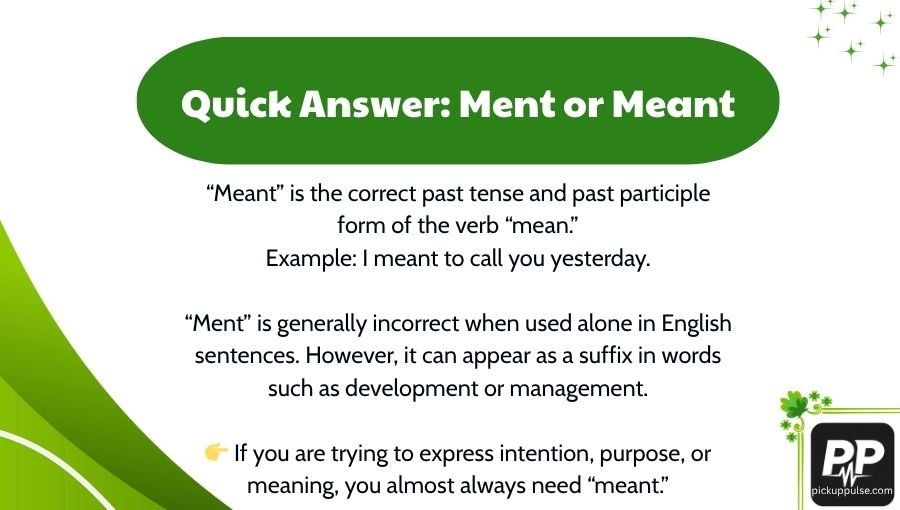
“Meant” is the correct past tense and past participle form of the verb “mean.”
Example: I meant to call you yesterday.
“Ment” is generally incorrect when used alone in English sentences. However, it can appear as a suffix in words such as development or management.
👉 If you are trying to express intention, purpose, or meaning, you almost always need “meant.”
Understanding the Basics of Ment or Meant
The confusion between ment or meant comes mainly from pronunciation. They often sound similar in fast speech, but grammatically they are completely different.
Core Difference
- Meant = Correct English word
- Ment = Usually incorrect as a standalone word
Comparison Table
| Form | Type | Meaning | Example | Correct/Incorrect |
|---|---|---|---|---|
| Meant | Verb (past tense of mean) | Intended or intended to say | “I meant no harm.” | ✅ Correct |
| Ment | Not usually a standalone word | Often a mistaken spelling | “I ment to help.” | ❌ Incorrect |
| -ment | Suffix | Forms nouns | “Achievement” | ✅ Correct as suffix |
Correct Meanings and Uses
What Does “Meant” Mean? 📖
The word “meant” is the past tense and past participle of the verb “mean.”
It is used to express:
- Intention
- Purpose
- Explanation
- Significance
Examples of “Meant”
- I meant to finish my homework.
- Meaning: I intended to finish it.
- She meant what she said.
- Meaning: Her words were sincere.
- This gift meant a lot to me.
- Meaning: The gift was emotionally important.
Sentence Breakdown
Sentence: “I meant to text you earlier.”
| Part | Explanation |
|---|---|
| I | Subject |
| meant | Past tense verb |
| to text | Intended action |
| you earlier | Additional detail |
Test Tip ✅
Replace the word with “intended.”
If the sentence still makes sense, use “meant.”
Example:
- “I intended to call you.”
- “I meant to call you.”
Both work correctly.
What Is “Ment”? 🤨
“Ment” is generally not accepted as a standalone English word in standard grammar.
People usually type “ment” because of:
- Fast typing
- Phonetic spelling
- Autocorrect errors
- Lack of grammar knowledge
Incorrect Example
❌ “I ment to reply sooner.”
Correct Version
✅ “I meant to reply sooner.”
Understanding “-ment” as a Suffix
Although “ment” alone is usually incorrect, it is very common as a suffix.
Examples
| Word | Meaning |
|---|---|
| Achievement | Something accomplished |
| Agreement | Mutual understanding |
| Improvement | The act of becoming better |
| Movement | Action or motion |
| Development | Growth or progress |
In these examples, “-ment” helps create nouns.
Case Study Section 📚
Workplace Email Example
Imagine an employee sends this email:
❌ “I ment to attach the report yesterday.”
Even though the message is understandable, the spelling mistake may appear unprofessional.
Correct Version
✅ “I meant to attach the report yesterday.”
Why This Matters
In professional communication:
- Grammar affects credibility
- Errors may reduce trust
- Clear writing improves understanding
A simple correction can make your writing look polished and professional.
Grammar Rules Explanation
According to grammar authorities such as Merriam-Webster and the Cambridge Dictionary, “meant” is the proper past tense of “mean.”
Verb Forms of “Mean”
| Tense | Form |
|---|---|
| Present | Mean |
| Past | Meant |
| Past Participle | Meant |
| Present Participle | Meaning |
Examples
- Present: “I mean what I say.”
- Past: “I meant what I said.”
- Participle: “She has meant well all along.”
Why “Ment” Is Incorrect
English verbs follow established spelling patterns.
The verb mean changes irregularly:
- Mean → Meant
Not:
- Mean → Ment ❌
English contains many irregular verbs:
| Base Verb | Past Tense |
|---|---|
| Keep | Kept |
| Feel | Felt |
| Mean | Meant |
The added “a” in “meant” follows the historical spelling structure of the word.
Common Mistakes 🚫
Why Do People Confuse Ment and Meant?
Several factors cause this error.
1. Fast Typing
People often skip letters while texting or typing quickly.
2. Pronunciation Similarity
In casual speech, “meant” may sound like “ment.”
3. Autocorrect Problems
Phones sometimes fail to correct contextual mistakes.
4. Weak Grammar Foundation
Some writers simply have not learned the correct form.
Similar Grammar Confusions Table
| Incorrect | Correct | Reason for Confusion |
|---|---|---|
| Its | It’s | Apostrophe confusion |
| Your | You’re | Sound alike |
| Their | They’re | Homophones |
| Than | Then | Similar pronunciation |
| Ment | Meant | Missing vowel |
| Loose | Lose | Spelling similarity |
Usage in Different Contexts 🌍
Everyday Conversation
People frequently use “meant” in casual speech.
Examples
- “I meant to buy milk.”
- “What did you mean?”
- “I never meant to upset you.”
Professional Writing
Correct grammar is critical in workplaces.
Examples
- “I meant to include the updated file.”
- “The manager meant that the deadline is final.”
Using “ment” in business communication may appear careless.
Creative Writing ✍️
Authors use “meant” to express emotional depth and character intentions.
Example
“She meant every word in her heartfelt letter.”
Social Media and Texting 📱
People often shorten words online, leading to mistakes.
Common Incorrect Text
❌ “I ment no offense lol”
Correct Version
✅ “I meant no offense lol”
Even in casual communication, correct grammar improves clarity.
Why It Matters ⭐
1. Clarity in Communication
Using the correct word prevents confusion.
Incorrect
“I ment it.”
Correct
“I meant it.”
The corrected version instantly looks more polished and understandable.
2. Professionalism
Employers, teachers, and clients notice grammar.
Small mistakes can create a negative impression.
Correct writing demonstrates:
- Attention to detail
- Education
- Professional competence
3. Writing Accuracy in Digital Communication
Today, most communication happens online.
Emails, messages, blog posts, and comments shape how people perceive you.
Correct grammar builds trust and authority.
Inspirational Quote 💡
“Words are the dress of thought.” — Samuel Johnson
Choosing the correct word helps your thoughts appear clear and intelligent.
Special Exception 🔍
Is “Ment” Ever Correct?
Yes, but only in specific situations.
1. As a Suffix
Examples:
- Government
- Improvement
- Excitement
2. Brand Names or Usernames
Some companies, apps, or usernames may intentionally use “Ment.”
Example:
- “Ment” as a startup name
- Social media handles
However, these are not standard grammar uses.
Quick Recap Checklist ✅
Simple Usage Table
| Question | If Yes → Use |
|---|---|
| Are you talking about intention? | Meant |
| Is it the past tense of “mean”? | Meant |
| Is it part of a larger noun like “achievement”? | -ment |
| Are you writing “ment” alone in a sentence? | Usually incorrect |
Practice Examples
Example 1
❌ “I ment to apologize.”
✅ “I meant to apologize.”
Example 2
❌ “She ment every word.”
✅ “She meant every word.”
Example 3
✅ “The achievement was impressive.”
Correct because “-ment” is a suffix here.
Deep Dive Into the Word “Meant” 📘
Historical Background
The word “meant” comes from Old English and evolved through centuries of language development. English irregular verbs often preserve older spellings.
Examples include:
- Sleep → Slept
- Deal → Dealt
- Mean → Meant
These forms became standardized in modern English dictionaries.
Pronunciation Guide
Correct Pronunciation
Meant → /ment/
This pronunciation explains why people accidentally spell it as “ment.”
English often contains silent or unexpected letters.
Examples:
| Word | Pronunciation |
|---|---|
| Knife | “nife” |
| Debt | “det” |
| Meant | “ment” |
The spelling stays historical even if pronunciation changes.
Memory Tricks to Remember “Meant” 🧠
Trick 1: Connect It to “Mean”
Since “meant” comes from “mean,” remember the original word.
- Mean → Meant
The “a” stays connected to the root word.
Trick 2: Think of Intentions
If the sentence involves intention or purpose, choose “meant.”
Example:
“I meant to help.”
Intentions = Meant
Trick 3: Read the Sentence Aloud
Hearing the full sentence often helps identify errors.
Ment vs Meant in Academic Writing 🎓
Academic writing requires precise grammar.
Professors and editors expect:
- Correct verb forms
- Standard spelling
- Clear sentence structure
Using “ment” incorrectly can reduce writing quality scores.
Academic Example
❌ “The author ment to emphasize social change.”
✅ “The author meant to emphasize social change.”
Ment or Meant in SEO Writing 🌐
Writers creating online content should use “meant” correctly because:
- Search engines favor quality grammar
- Readers trust accurate writing
- Poor grammar can increase bounce rates
Google’s algorithms increasingly reward:
- Clarity
- Readability
- Expertise
Correct grammar contributes to all three.
Ment or Meant in Spoken English 🎤
In spoken English, listeners rarely notice the spelling difference because both sound similar.
However, spelling matters in:
- Emails
- Essays
- Captions
- Applications
- Public posts
Writing preserves language accuracy.
Psychological Impact of Grammar Errors 🧩
Research suggests that readers judge professionalism based on writing quality.
Grammar mistakes may lead readers to assume:
- Carelessness
- Weak attention to detail
- Lower credibility
Correct spelling creates stronger first impressions.
Examples of “Meant” in Popular Expressions
Here are common English phrases using “meant.”
| Expression | Meaning |
|---|---|
| “No offense meant” | No intention to hurt |
| “Meant to be” | Destined |
| “What I meant was…” | Clarification |
| “You meant well” | Good intentions |
These expressions appear frequently in everyday English.
Mini Quiz 📝
Choose the correct word.
1. I _____ to send the package yesterday.
✅ Answer: Meant
2. She _____ no harm.
✅ Answer: Meant
3. The improve_____ was noticeable.
✅ Answer: -ment
Frequently Asked Questions (FAQs) ❓
1. Is “ment” a real word?
“Ment” is generally not a standalone word in standard English grammar. It is mostly seen as a suffix in words like “agreement” or “development.”
2. Which is correct: “I ment it” or “I meant it”?
The correct sentence is:
✅ “I meant it.”
“Meant” is the proper past tense of “mean.”
3. Why do people write “ment” instead of “meant”?
People often confuse them because:
- They sound similar
- Fast typing causes mistakes
- Autocorrect may fail
- English spelling can be tricky
4. Can “ment” ever be used correctly?
Yes. “Ment” works correctly as a suffix in words like:
- Enjoyment
- Improvement
- Excitement
However, it is usually incorrect when written alone.
5. Is “meant” an irregular verb?
Yes. “Mean” changes to “meant,” making it an irregular verb.
6. How can I remember the correct spelling of “meant”?
Connect it to the root word “mean.”
- Mean → Meant
If the sentence involves intention, use “meant.”
Conclusion 🎯
The difference between ment or meant is simpler than it first appears. “Meant” is the correct past tense of the verb “mean,” while “ment” is usually incorrect when used by itself. The confusion happens because both forms sound nearly identical in spoken English, but grammar rules clearly favor “meant” in sentences about intention, purpose, or meaning.
Remember this simple rule:
✅ If you can replace the word with “intended,” use meant.
✅ If “ment” appears alone, it is probably a spelling mistake.
Understanding this distinction improves communication, strengthens professional writing, and helps you avoid common grammar errors. Whether you are writing emails, essays, social media posts, or creative content, correct spelling reflects confidence and clarity.
Language shapes how people understand your ideas. One small letter can completely change how polished your writing appears. ✨
Use “meant” with confidence, and your writing will instantly sound more accurate, professional, and trustworthy.
Also Read This: Shark Tattoo Meaning

Hi, I’m Daxter Wilde, an expert in names who enjoys designing creative and distinctive nicknames. My goal is to turn simple names into something fun, memorable, and full of character.