Propose vs Purpose: Meaning, Difference, Grammar Rules, and Correct Usage (Complete Guide)
Have you ever struggled to understand the difference between propose vs purpose while writing a sentence? You are not alone. Many English learners, professionals, and even native speakers get confused between these two words because they look similar, sound somewhat related, and are often misused in digital communication.
The confusion around propose vs purpose comes from the fact that both words appear in formal and informal writing, but they carry completely different meanings. One is an action verb used for suggesting ideas, while the other is a noun that represents intention or reason. Mixing them up can completely change the meaning of a sentence.
For example:
- “I propose a new idea” ✔️
- “What is your purpose?” ✔️
- “I purpose a meeting” ❌ (Incorrect usage)
Understanding propose vs purpose is essential for clear communication, especially in academic writing, business emails, and professional conversations. In this article, we will break everything down in a simple, structured, and practical way so you never confuse them again. 😊
Quick Answer: Propose vs Purpose
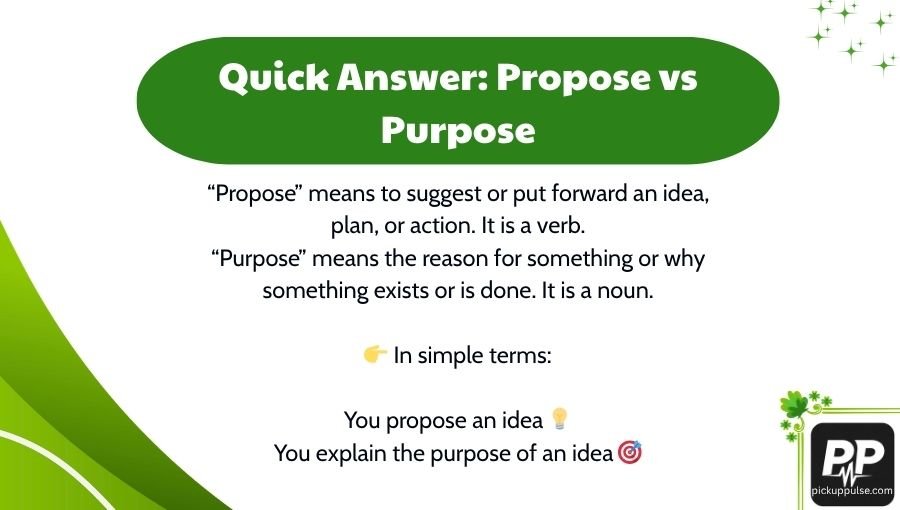
“Propose” means to suggest or put forward an idea, plan, or action. It is a verb.
“Purpose” means the reason for something or why something exists or is done. It is a noun.
👉 In simple terms:
- You propose an idea 💡
- You explain the purpose of an idea 🎯
Understanding the Basics of Propose vs Purpose
To fully understand the difference between propose and purpose, we need to break them down in terms of grammar, function, and usage.
| Feature | Propose | Purpose |
|---|---|---|
| Form | Verb | Noun |
| Type | Action word | Abstract concept |
| Meaning | To suggest or offer an idea | The reason for something |
| Example | I propose a solution | The purpose is clarity |
| Correct/Incorrect | “I propose a plan” ✔️ | “I purpose a plan” ❌ |
🔹 Key Insight
- Propose is something you do
- Purpose is something you have or explain
Correct Meanings & Uses of “Propose”
🔹 1. To Suggest an Idea or Plan
The most common use of propose is when you present an idea formally or informally.
Example:
- “I propose a new marketing strategy.”
Breakdown:
- Subject: I
- Verb: propose
- Object: a new marketing strategy
💡 Test Tip: If you can replace the word with “suggest,” then “propose” is correct.
🔹 2. To Recommend in Formal Settings
In business or academic environments, propose often means to officially recommend something.
Example:
- “The manager proposed a restructuring plan.”
🔹 3. To Intend or Aim (Less Common Usage)
Sometimes, propose can mean to intend something.
Example:
- “What do you propose to do next?”
Correct Meaning & Uses of “Purpose”
🔹 1. Reason for Something
This is the most common meaning of purpose.
Example:
- “The purpose of this meeting is to discuss performance.”
Breakdown:
- “Purpose” = reason
- “of this meeting” = what is being explained
💡 Test Tip: If you can replace it with “reason,” use purpose.
🔹 2. Intention or Goal
Example:
- “She came with a clear purpose.”
🔹 3. Function of Something
Example:
- “The purpose of this tool is to improve accuracy.”
Case Study: Real-Life Usage Example
📧 Workplace Email Example
Incorrect:
- “I purpose a new schedule for the team.”
Correct:
- “I propose a new schedule for the team.”
Now consider a response email:
- “What is the purpose of this new schedule?”
🔍 Analysis:
- Propose = action of suggesting the schedule
- Purpose = reason behind the schedule
This distinction is critical in professional communication where clarity matters.
Grammar Rules Explanation (Why One Is Correct and the Other Is Not)
According to standard grammar references such as Merriam-Webster and Oxford English Dictionary:
- Propose is a verb derived from Latin proponere, meaning “to put forward.”
- Purpose comes from Old French porpos and is used as a noun meaning “intention or aim.”
⚠️ Important Rule:
- You cannot use purpose as a verb in standard modern English.
- You cannot use propose as a noun.
This is why sentences like:
- ❌ “I purpose a solution”
- ❌ “The propose of this is…”
are grammatically incorrect.
Common Mistakes
🔹 Why People Confuse Propose and Purpose
People often confuse these words because of:
- Fast typing ⌨️
- Autocorrect errors 📱
- Similar spelling patterns
- Lack of grammar awareness
🔹 Similar Grammar Confusion Table
| Confused Words | Incorrect Example | Correct Example | Reason |
|---|---|---|---|
| it’s / its | The cat lost it’s toy ❌ | The cat lost its toy ✔️ | Possessive vs contraction |
| your / you’re | Your amazing ❌ | You’re amazing ✔️ | Possession vs “you are” |
| propose / purpose | I purpose a plan ❌ | I propose a plan ✔️ | Verb vs noun confusion |
Usage in Different Contexts
🔹 Everyday Conversation 🗣️
- “I propose we go out for dinner.”
- “What is the purpose of this app?”
🔹 Professional Writing 💼
- “We propose a revised business model.”
- “The purpose of this report is analysis.”
🔹 Creative Writing ✍️
- “He proposed a daring escape plan under the moonlight.”
- “Her purpose was hidden behind every action she took.”
🔹 Social Media / Texting 📱
- “I propose pizza tonight 🍕”
- “What’s the purpose of this trend?”
Why It Matters (Important )
Understanding the difference between propose and purpose is not just grammar theory—it directly impacts how clearly you communicate.
Why it matters:
- Improves professionalism in writing
- Prevents misunderstandings
- Enhances academic performance
- Builds communication confidence
“Clarity is not optional in communication—it is the foundation of understanding.”
Special Exception
There are no major exceptions where purpose is used as a verb in standard English. However:
- In rare informal or creative writing, people may play with language stylistically.
- This is not accepted in academic, business, or formal grammar standards.
Quick Recap Checklist
| Question | If Yes → Use |
|---|---|
| Are you suggesting something? | Use propose |
| Are you explaining a reason? | Use purpose |
| Is it an action? | Use propose |
| Is it a reason or goal? | Use purpose |
🧠 Practice Examples:
- I ___ a new idea for improvement. → propose
- What is the ___ of this tool? → purpose
- She ___ a partnership. → proposes
FAQs: Propose vs Purpose
What is the main difference between propose and purpose?
Propose is a verb meaning to suggest something. Purpose is a noun meaning the reason for something.
Can “purpose” be used as a verb?
No, in standard English, purpose is not used as a verb.
Is it correct to say “I purpose a plan”?
No, the correct sentence is “I propose a plan.”
How can I remember the difference easily?
Think:
- Propose = Present an idea 💡
- Purpose = Why something exists 🎯
Are propose and purpose related words?
They are not directly related in meaning, even though they look similar.
Why do people confuse them so often?
Because of similar spelling, fast typing, and lack of grammar awareness.
Conclusion (Final Summary)
Understanding the difference between propose and purpose is essential for clear and effective communication. While propose is an action word used when suggesting ideas, purpose is a noun that explains the reason behind something.
Mixing them up can lead to confusion, especially in professional or academic settings. However, once you remember the simple rule—propose = suggest, purpose = reason—you can avoid common mistakes effortlessly.
Clear writing is powerful writing. And mastering small but important grammar distinctions like this helps you communicate with confidence, accuracy, and impact in every situation.
Also Read This: Company-Wide or Companywide

Hi, I’m Rylan Dorsey, a creative wordsmith who loves crafting pick-up lines, puns, and nicknames. At PickupPulse.com, I share fun, original content designed to entertain and bring a smile.