Invision or Envision: Meaning, Difference, and Correct Usage (Complete Guide)
Have you ever been confused about whether to write “invision or envision” while typing a sentence? 🤔 This is a very common spelling doubt in English, especially in professional writing, emails, and social media captions. Many people hesitate because both versions sound almost identical when spoken, but only one is actually correct in standard English.
The confusion is even more understandable because autocorrect doesn’t always flag the mistake, and the presence of the brand name InVision makes things even trickier. As a result, writers often mix up the correct spelling without realizing it.
In reality, only one form is accepted when you are talking about imagining or picturing something in the future. The other is either a misspelling or a proper noun used for branding. In this article, we’ll clearly break down everything you need to know so you never confuse invision or envision again. You’ll learn meanings, rules, examples, and simple memory tricks to make the correct usage stick instantly ✨
Quick Answer: Invision or Envision?
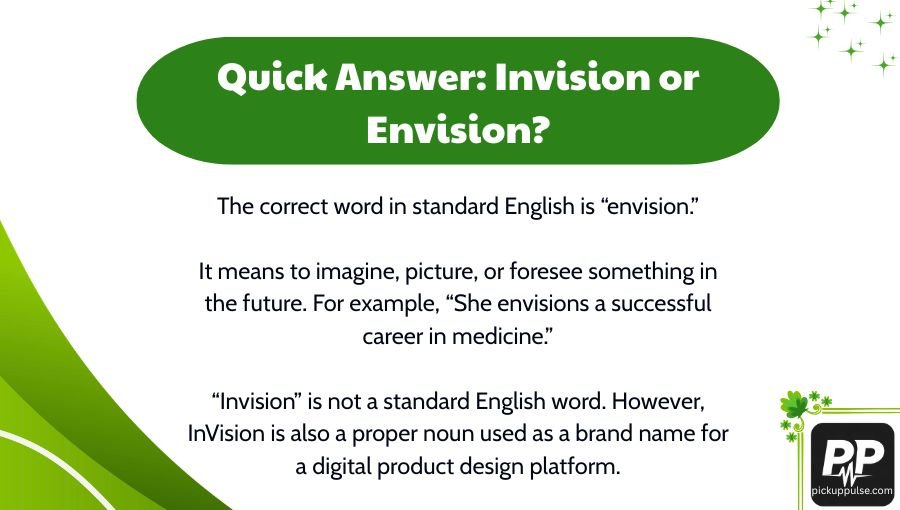
The correct word in standard English is “envision.”
It means to imagine, picture, or foresee something in the future. For example, “She envisions a successful career in medicine.”
“Invision” is not a standard English word. However, InVision is also a proper noun used as a brand name for a digital product design platform.
Understanding the Basics: Envision vs Invision
To fully understand the confusion around invision or envision, we need to break down the meaning, usage, and differences clearly.
Key Insight
- ✔️ Envision = Correct verb (to imagine something)
- ❌ Invision = Incorrect spelling in general English
- 🏢 InVision = Brand name (proper noun)
Comparison Table: Envision vs Invision
| Form | Type | Meaning | Example Sentence | Correct/Incorrect |
|---|---|---|---|---|
| Envision | Verb | To imagine or foresee something | I envision a better future for my family. | ✅ Correct |
| Invision | Non-standard | Common misspelling of envision | I invision success. | ❌ Incorrect |
| InVision | Proper noun | Tech company name (design collaboration tool) | I use InVision for UI design projects. | ✅ Correct (Brand) |
Correct Meaning and Usage of “Envision”
The word envision is a verb used when someone imagines or mentally pictures something that could happen in the future.
1. Envision = To Imagine the Future
This is the most common use.
Example:
- “She envisions becoming a doctor one day.”
👉 Breakdown:
- She = subject
- envisions = action (imagines)
- becoming a doctor = imagined future goal
2. Envision = To Plan Mentally
Sometimes it also means mentally preparing or planning something.
Example:
- “The company envisions expanding into global markets.”
3. Envision = Creative Visualization
Used in storytelling, leadership, and creativity.
Example:
- “He envisions a world without poverty.”
⭐ Test Tip:
If you can replace the word with “imagine” or “picture”, then “envision” is correct.
✔ I envision success → I imagine success
❌ I invision success → incorrect spelling
Case Study: Real-Life Usage Example
Let’s see how this plays out in real communication.
📧 Workplace Email Example
Subject: Project Vision Update
“Dear Team,
As we move forward with this initiative, I envision a product that will simplify user experience and increase customer engagement. Our goal is to deliver something innovative and scalable.”
👉 Why “envision” works here:
- It expresses future thinking
- It sounds professional
- It aligns with business communication standards
Now imagine if someone wrote:
❌ “I invision a better product…”
This would immediately look like a spelling mistake and reduce credibility.
Grammar Rules Explanation
According to authoritative dictionaries like Merriam-Webster, the correct spelling is envision, not invision.
Why “Envision” is Correct:
- Comes from the prefix “en-” meaning “to cause to be”
- Root word: vision
- Combined meaning: “to cause to see in the mind”
Why “Invision” is Incorrect:
- “In-” is not a valid prefix for this verb
- It is not recognized in standard English dictionaries
- It likely arises from pronunciation confusion
📌 In short:
- Envision = linguistically correct formation
- Invision = phonetic mistake or brand name
Common Mistakes
Many people confuse “envision” with similar words due to writing habits and technology.
Why This Mistake Happens:
- ⚡ Fast typing without proofreading
- 🤖 Autocorrect errors
- 🧠 Mishearing the word in speech
- 📱 Informal texting habits
Similar Grammar Confusions Table
| Incorrect | Correct | Reason for Confusion |
|---|---|---|
| invision | envision | Sound similarity |
| it’s | its | Apostrophe misuse |
| your | you’re | contraction confusion |
| affect | effect | similar pronunciation |
| then | than | grammatical role confusion |
Usage in Different Contexts
🗣️ Everyday Conversation
“I envision my future as peaceful and happy.”
💼 Professional Writing
“The board envisions a 10% growth in revenue next year.”
✍️ Creative Writing
“She envisioned a city glowing under endless stars.”
📱 Social Media
“Manifest what you envision ✨”
Why It Matters
Using correct spelling like envision is more than grammar—it’s about clarity and credibility.
“Words shape perception, and precision builds trust.”
Why It’s Important:
- ✔ Improves communication clarity
- ✔ Enhances professional image
- ✔ Avoids misunderstandings
- ✔ Strengthens writing quality
Even a small spelling mistake like “invision” can affect how your message is perceived.
Special Exception: InVision (Brand Name)
There is one important exception.
🏢 InVision (Capitalized)
- A digital product design platform
- Used by designers and teams
- Proper noun, not a verb
Example:
- “We designed the prototype using InVision.”
📌 Important:
- Only correct when referring to the company
- Not interchangeable with “envision”
Quick Recap Checklist
| Question | If Yes → Use |
|---|---|
| Are you talking about imagination or future ideas? | Envision |
| Are you referring to a design software company? | InVision |
| Did you type “invision” as a verb? | Correct to “envision” |
📝 Practice Examples
- I ______ a peaceful future. → envision
- The team uses ______ for UI design. → InVision
- She ______ success in her career. → envisions
FAQs: Invision or Envision
Is “invision” a real English word?
No, “invision” is not a standard English word. The correct verb is envision.
What does “envision” mean?
It means to imagine, picture, or foresee something in the future.
Why do people write “invision”?
It happens due to pronunciation confusion, typing errors, or autocorrect mistakes.
Is “InVision” correct?
Yes, but only as a brand name for a design software company.
What is a simple way to remember “envision”?
Think: en + vision = create a vision in your mind 🧠✨
Can “envision” be used in formal writing?
Yes, it is widely used in academic, business, and professional contexts.
Conclusion
Understanding the difference between invision or envision is a small but powerful step toward better writing clarity. The correct verb in standard English is envision, which means to imagine or mentally picture a future possibility. Whether you are writing an email, an essay, or a social media post, using the correct spelling helps you sound more professional and precise.
On the other hand, “invision” is not grammatically correct in general usage and should be avoided unless you are referring to the specific brand InVision.
Language accuracy builds credibility, and small details like this can significantly improve how your message is received. Once you remember that “envision” combines “en” + “vision”, the confusion disappears quickly.
So next time you hesitate between invision or envision, remember this simple rule: if it’s about imagination or the future, always choose envision. ✨
Also Read This: Nighttime or Night-Time

Hi, I’m Zyler Knox, an expert in names and unique nickname creation. I specialize in developing fresh, modern, and expressive nicknames that add personality to every name.