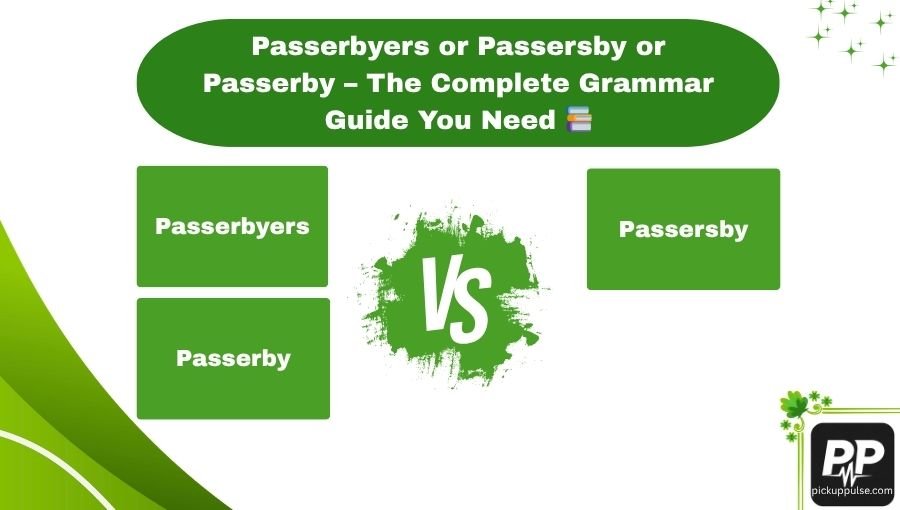
Passerbyers or Passersby or Passerby – The Complete Grammar Guide You Need 📚
Quick Answer: Passerbyers or Passersby or Passerby?
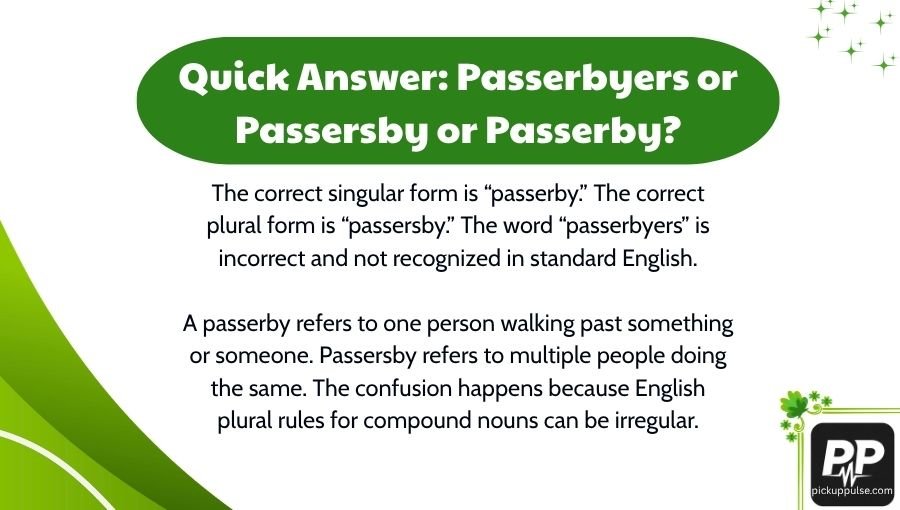
The correct singular form is “passerby.” The correct plural form is “passersby.” The word “passerbyers” is incorrect and not recognized in standard English.
A passerby refers to one person walking past something or someone. Passersby refers to multiple people doing the same. The confusion happens because English plural rules for compound nouns can be irregular.
Understanding the Basics (Passerby vs Passersby vs Passerbyers)
Let’s simplify it:
- Passerby (singular) → one person walking past
- Passersby (plural) → more than one person walking past
- Passerbyers (incorrect) → not a valid English word ❌
Why “passersby” is correct
English forms the plural by modifying the main noun in a compound structure. In “passerby,” the main noun is “passer” (not “by”). So the plural becomes passers + by = passersby.
Comparison Table
| Form | Type | Meaning | Example Sentence | Correct/Incorrect |
|---|---|---|---|---|
| passerby | Singular | One person walking past | A passerby stopped to help. | Correct ✅ |
| passersby | Plural | Multiple people walking past | Passersby gathered at the scene. | Correct ✅ |
| passerbyers | Plural (?) | Intended plural form (invalid) | “Passerbyers watched the accident.” | Incorrect ❌ |
Correct Meaning and Usage of “Passerby”
1. Meaning of Passerby
A passerby is a person who happens to be walking past a place, often without being involved in what is happening.
📌 Example:
- A passerby noticed the wallet on the ground.
Sentence Breakdown:
- “A” = singular article
- “passerby” = subject (one person walking past)
- “noticed the wallet” = action
Test Tip 🧠
If you can replace the word with “one person walking past,” use passerby.
Correct Meaning and Usage of “Passersby”
1. Meaning of Passersby
Passersby refers to multiple people walking past a location.
📌 Example:
- Passersby stopped to watch the street performance.
Sentence Breakdown:
- “Passersby” = plural subject
- “stopped” = verb (plural agreement)
- “to watch the street performance” = action phrase
Test Tip 🧠
If more than one person is involved, always use passersby, not “passerbyers.”
Why “Passerbyers” is Incorrect ❌
“Passerbyers” is a common mistake caused by overgeneralizing English plural rules. People often add “-ers” or “-s” without understanding compound noun structure.
Why it feels correct but isn’t:
- “Passer” sounds like it should become “passers”
- “By” seems like it needs “-ers” added for pluralization
- Combined assumption leads to “passerbyers”
But English grammar does not support this formation.
Case Study: Real-Life Usage Example 🏙️
Situation: Workplace Incident Report
An employee writes an incident report:
❌ Incorrect:
“Passerbyers saw the accident and called emergency services.”
✔ Correct:
“Passersby saw the accident and called emergency services.”
Why it matters:
- Reports require formal accuracy
- “Passerbyers” may reduce credibility
- “Passersby” is universally recognized in professional writing
Grammar Rules Explanation (Authority-Based Insight)
According to standard dictionaries like Merriam-Webster and Oxford English Dictionary, the correct plural form of “passerby” is passersby.
Rule Summary:
- Compound noun → plural is applied to the primary noun
- “Passer + by” → “passers + by”
Key Grammar Insight:
English does NOT pluralize compound nouns by adding “-ers” at the end unless the base word requires it.
This is why:
- attorney general → attorneys general
- passerby → passersby
Common Mistakes 🚫
Why people make these mistakes:
- Fast typing on mobile keyboards 📱
- Auto-correct interference
- Misunderstanding compound noun rules
- Influence from spoken English
Similar Grammar Confusions Table
| Incorrect Form | Correct Form | Reason for Confusion |
|---|---|---|
| passerbyers | passersby | Overgeneralized plural rule |
| childs | children | Irregular plural form |
| sheeps | sheep | No plural change |
| advices | advice | Uncountable noun error |
| informations | information | Uncountable noun error |
Usage in Different Contexts
1. Everyday Conversation 🗣️
- “A passerby helped me find my phone.”
2. Professional Writing 🧾
- “Passersby were interviewed for eyewitness accounts.”
3. Creative Writing ✍️
- “The city lights reflected in the eyes of passersby wandering the night streets.”
4. Social Media / Texting 📲
- “So many passersby stopped to watch this moment!”
Why It Matters (Importance of Correct Usage)
Using correct grammar isn’t just about rules—it’s about clarity, credibility, and communication quality.
Benefits:
- Improves writing professionalism
- Avoids misunderstandings
- Enhances SEO content quality
- Builds trust with readers
📌 As George Orwell famously emphasized:
“Good writing is clear thinking made visible.”
Special Exception
There are no official exceptions for “passersby.” However, informal writing or social media may occasionally show incorrect forms like “passerbyers,” but these are not accepted in academic or professional contexts.
Quick Recap Checklist ✔️
| Question | If Yes → Use |
|---|---|
| One person walking past? | passerby |
| More than one person? | passersby |
| Thinking of adding “-ers”? | Do NOT use passerbyers |
Practice Examples:
- A ___ helped the injured man. → passerby
- The ___ stopped to take photos. → passersby
- ___ is not a correct English word. → passerbyers
FAQs Passerbyers or Passersby or Passerby❓
1. Is “passerbyers” a real word?
No, “passerbyers” is not a real or accepted English word. It is grammatically incorrect.
2. What is the correct plural of passerby?
The correct plural is passersby.
3. Why is it not “passerbyers”?
Because English forms plurals of compound nouns by modifying the main word (“passer”), not by adding “-ers.”
4. Is “passerby” singular or plural?
“Passerby” is singular. It refers to one person walking past.
5. Can I write “passers-by” with a hyphen?
Yes, “passers-by” is an accepted alternative spelling, though “passersby” is more common in modern usage.
6. Is it formal or informal?
“Passersby” is neutral and can be used in both formal and informal writing.
Conclusion
The confusion between passerby, passersby, and passerbyers is more common than it seems, but the rule is actually simple once understood. The correct singular form is passerby, while the correct plural form is passersby. The form “passerbyers” is not recognized in standard English and should be avoided in all types of writing.
This difference exists because English compound nouns follow structural plural rules rather than simple suffix additions. Once you understand that “passer” is the main noun, the correct plural naturally becomes clear.
Using the correct form improves clarity, professionalism, and credibility in both written and spoken communication. Whether you’re writing an essay, report, or casual message, choosing the right word helps you sound more precise and confident.
In short, remember this simple rule:
👉 One person = passerby
👉 Many people = passersby
👉 Never use = passerbyers
Mastering small grammar details like this makes a big difference in strong communication.
Also Read This: Brite vs Bright

Hi, I’m Daxter Wilde, an expert in names who enjoys designing creative and distinctive nicknames. My goal is to turn simple names into something fun, memorable, and full of character.